


The Role of Vegetation Cover in Enhancing Sediment Stability: A Community Engagement Perspective
March 4, 2026 | Taylor M. Hardy
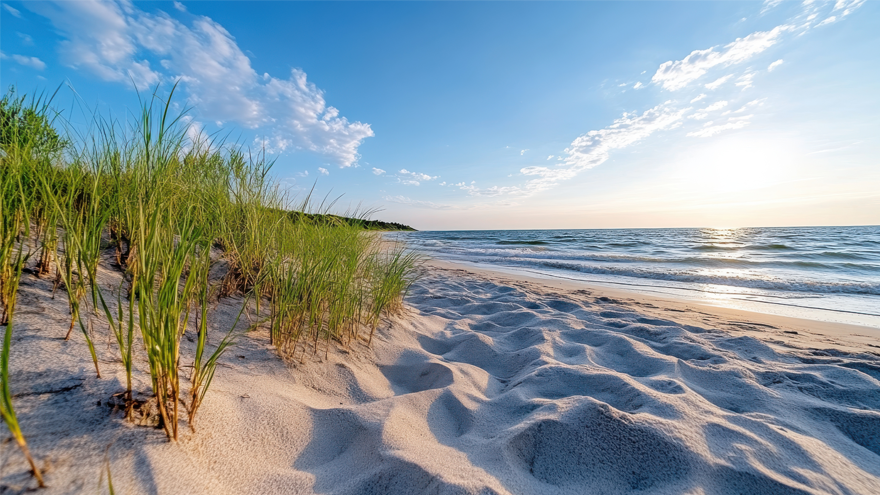
The amount of vegetation contained in an area plays a vital role in maintaining the structural integrity of soil and the stabilization of sediment. In the context of land management, it is crucial to understand the mechanisms behind this relationship between sediment stability and vegetation cover. This is especially important in areas prone to erosion, deforestation, and urbanization. Vegetation cover, or lack thereof, has come increasingly to influence the nature and efficacy of geomorphic processes (Orme, 2014). Interconnections between soil structure and vegetative systems, exploring the environmental benefits and implications for sustainable land use will be examined.
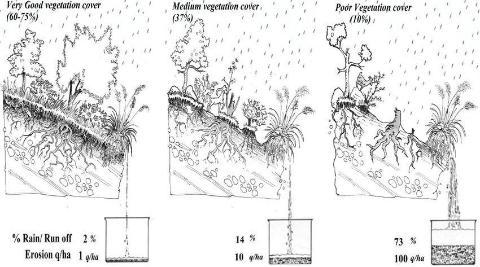
Figure 1: A dense vegetation cover protects the soil and helps regulate water movement and surface erosion. The figure shows the variations in erosion and runoff with the variation of soil coverage (Ortigão 13).
Defining Vegetation Cover:
Vegetation cover refers to the percentage or ratio of plant-covered area to the total area of a given site, such as district, street, or park. It includes various types of plants, such as trees, shrubs, and grasses (Zhang 103340). Vegetation cover can be naturally occurring, like forest and grasslands, or it can be planted by humans for a specific purpose, this includes urban landscaping or agricultural operations. The density and composition of an area’s vegetation plays an essential position in defending environmental/ecological balance, and maintaining natural functions of a system. One of the most significant services that vegetation provides is in preventing soil erosion and maintaining sediment stability.
Understanding Erosion and Sediment Stability:
Sediment stability refers to the stability of fine-grained sediments under external forces, mainly including shear strength, compressive strength, and erosion resistance (Wang 248). The stability of a sedimentary structure is the sediment’s resistance to be moved; erosion of sediment is the actual process of destabilizing and transporting that sediment. Erosion factors can be natural or anthropogenic- climate, human traffic, soil properties, vegetation cover, topography, land use, and weather. When sediment is stable it remains secure in its position, maintaining the landscape’s position and structure; erosion disrupts this by dislodging sediment from its original position. When sediment becomes unstable, the integrity of the landscape becomes undermined, leading to ecological degradation and loss of habitat.
Mechanisms of Vegetation in Sediment Stabilization:
The connection between plant life and soil stability is fundamental to preventing erosion, especially on slopes or floodplains. Plant roots form dense networks that physically binds sediment together, the stronger the root system is, the more resilient the landscape is to become disrupted from erosion factors. During rain events, root systems act as an anchor; this anchoring service is very important in the stabilization of slopes. Runoff and consecutive erosion are observed to be low when infiltration is high (Shaikh 1-8). Plant life also shields the ground from direct rainfall, reducing the erosive force from rainfall. The higher vegetation cover an area has, the less wind-driven erosion the area is prone to. This is because plants act as a physical buffer between sediment and wind, preventing some disruption of loose soils. In riparian areas and shorelines, vegetation helps to intercept and trap sediment that would otherwise be carried downstream; this slows down water velocity and decreases water turbidity, which further encourages plant growth. Under the surface, plants regulate soil moisture levels and increase soil porosity with root systems by pulling water deep into the soil, which allows for better water infiltration. This increase in absorbance provides better, more stable sediment conditions by reducing runoff; runoff is a major driver of erosive activity. Lastly, plants contribute to a natural process of nutrient cycling by extracting nutrients from the air and soil, then recycling vital nutrients back to an ecosystem through decomposition. This natural process increases soil health, providing proper balance to an ecosystem, promoting future plant growth, and therefore contributing towards greater erosion diminution. The protection and conservation of natural vegetation (PRO) has the strongest effect on soil quality (SOC, BD) and erosion (Sloss, SSY) (Vanacker, 2022).
An example of a local project to improve plant communities in the attempt to mitigate erosive behaviors is the Pensacola & Perdido Bays Estuary Program’s Carpenter Creek Restoration project. The project aims to enhance stormwater management by expanding the use of green infrastructure practices. Also, promote and facilitate the development of living shorelines as a sustainable alternative to shoreline armoring to reduce erosion and sediment inputs (CCMP, 2022). Green infrastructure is the practice of using natural systems in the management of stormwater, green infrastructure aims to reduce erosion, increase infiltration, and increase the stability of soil structures. Green infrastructure can be bioretention areas, permeable pavements, swales, constructed wetlands, land conservation areas, living shorelines or green spaces in urban areas such as green parking, planter boxes, and urban landscaping. The Carpenter Creek Restoration project CCMP plan implements its Community Grant Program, a program designed to engage community members through grants to groups such as OysterCorps. Pensacola & Perdido Bays Estuary Program also values the contributions of volunteers greatly, volunteers support the program and give back to their community by involving themselves with education, outreach, habitat restoration, and monitoring.
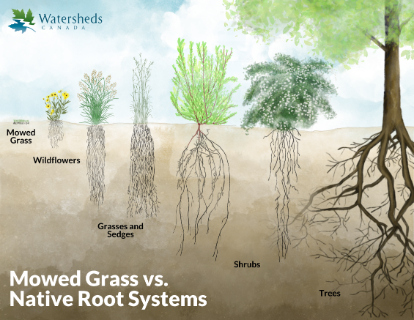
(Penn State Extension) Figure 2: Different plant types have different depths, therefore different effects on soil structure.
Mitigation of threats to vegetation and sediment stability:
Ecological degradation is typically a positive feedback loop, this means that there will be no improvement in natural conditions unless action is taken. Urbanization only increases runoff and decreases vegetation cover, multiplying rates of erosion. Invasive species also have a negative impact on the ability for native vegetation to thrive by basically strangling out native species. These natural processes are disrupted by an immeasurable number of anthropogenic causes. Plants contribute to nutrient cycling, providing nutrients to soils, and therefore encouraging more biological growth in that area. Because of this nutrient cycle, pollution is also a large factor here.
In order to mitigate these effects, community action can certainly be taken. You can opt to support and participate in citizen science projects, encourage local workshops and educational activities. Volunteering is a great way to become involved with local environmental initiatives, every bit of positive impact is important. There are many agencies/organizations to volunteer with such as the Federal Department of Environmental Protection, Pensacola and Perdido Bays Estuary Program, Keep Santa Rosa Beautiful, and U.S. Fish and Wildlife Service; The links to these organizations will be listed below. Volunteering is not only great because of the service you are providing the environment; volunteering can produce a pack mentality through shared goals and a stronger sense of community. Even helping out with the smallest tasks can make a real difference to the lives of people and organizations in need. Dedicating your time as a volunteer helps you make new friends, expand your network, and boost your social skills (HelpGuide, 2024). If you do not have a desire to volunteer, consider planting your own native species yard, or promoting environmental initiatives through social media. Social media is an undervalued resource, awareness is a currency in itself.
You can make a real difference in your community through engagement. Understanding the natural processes and relationships behind vegetation cover, sediment structure/stability, and erosion is the first step to mitigating these causes and effects. A grassroots transformative change led by local communities, cities, and businesses can offer a promising approach for achieving sustainability (Moallemi, 2020).
Volunteer Opportunities for Community Engagement
- Federal Department of Environmental Protection
- Pensacola and Perdido Bays Estuary Program
- Keep Santa Rosa Beautiful
- S. Fish and Wildlife Service
Bibliography
Scholarly Sources:
Orme, A.R. “Tectonism, climate, and geomorphology spatial and Temporal Perspectives ☆.” Reference Module in Earth Systems and Environmental Sciences, 2014, https://doi.org/10.1016/b978-0-12-409548-9.09387-8.
Zhang, Jian, et al. “A clustering review of vegetation-indicating parameters in urban thermal environment studies towards various factors.” Journal of Thermal Biology, vol. 110, Dec. 2022, p. 103340, https://doi.org/10.1016/j.jtherbio.2022.103340.
Wang, Qinjun, et al. “A review of research on the stability of fine-grained sediments in debris flows.” Geosciences, vol. 14, no. 9, 23 Sept. 2024, p. 248, https://doi.org/10.3390/geosciences14090248.
Vanacker, V., Molina, A., Rosas, M. A., Bonnesoeur, V., Román-Dañobeytia, F., Ochoa-Tocachi, B. F., and Buytaert, W.: The effect of natural infrastructure on water erosion mitigation in the Andes, SOIL, 8, 133–147, https://doi.org/10.5194/soil-8-133-2022, 2022.
Shaikh, Janarul, et al. “Influence of infiltration on soil erosion in green infrastructures.” Acta Horticulturae et Regiotecturae, vol. 24, no. 1, 1 May 2021, pp. 1–8, https://doi.org/10.2478/ahr-2021-0018.
Moallemi, Enayat A., et al. “Achieving the sustainable development goals requires transdisciplinary innovation at the local scale.” One Earth, vol. 3, no. 3, Sept. 2020, pp. 300–313, https://doi.org/10.1016/j.oneear.2020.08.006.
Infographics:
Ortigão, J. A. R., and Alberto S. F. J. Sayao. “Plant Functions.” Handbook of Slope Stabilisation Engineering, Springer Verlag, Berlin, 2004, p. 13.
“The Role of Trees and Forests in Healthy Watersheds.” Penn State Extension, extension.psu.edu/the-role-of-trees-and-forests-in-healthy-watersheds. Accessed 15 Mar. 2025.
Other Cited Readings:
“2022 Comprehensive Conservation and Management Plan.” Pensacola & Perdido Bays Estuary Program, 2022, indd.adobe.com/view/c2f4ee73-a2a8-456d-b4bf-75ae16895a87?transition
“Volunteering and Its Surprising Benefits.” HelpGuide.Org, 21 Aug. 2024, www.helpguide.org/mental-health/wellbeing/volunteering-and-its-surprising-benefits.


