


UWF Anthro at SEAC
UWF Anthro @ SEAC
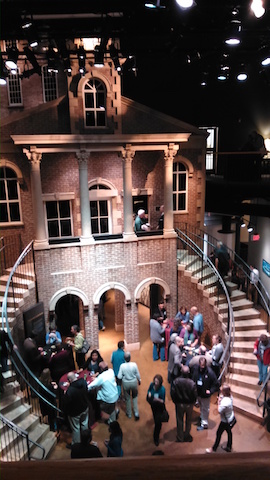
Students, faculty, staff, and alumni of the Division of Anthropology and Archaeology at the University of West Florida recently attended the 71st annual Southeastern Archaeological Conference in Greenville, South Carolina. The conference, which was first convened in 1938, regularly hosts hundreds of professional archaeologists from across the country who showcase their groundbreaking work in understanding the historic and prehistoric past of the southeastern United States.
Current graduate students presented original research on sites and artifacts from Florida. , along with Dr. Ramie Gougeon, discussed how to document cave sites in Florida, and used the Division’s X-ray fluorescence (XRF) spectrometer to explain the composition of Archaic period copper beads. talked about Apalacha-Creek ceramics, while reported on work at Fort San Marcos de Apalachee.
Archaeologists in the Division also contributed research. Adrianne Sams presented on the Simpson House, one of the focuses of the 2014 field school at Arcadia Mill, and Jennifer Melcher discussed the last mission in northwest Florida. Additional work was presented by Florida Public Archaeology Network researchers. Sarah Miller, Kevin Gidusko, and Ryan Harke looked at historic cemeteries and African-American burial practices in Florida. Emily Jane Murray conveyed information on methods of community archaeology, and Sarah Nohe presented on vernacular watercraft in Florida and Cuba.
Alumni of the Department of Anthropology were active at this year’s SEAC, demonstrating the lasting influence of UWF’s hands-on approach to educating students. In Florida archaeology, Trevor Duke dealt with invertebrate faunal remains, Morgan Smith looked at ivory points from submerged sites, and Lauren Walls discussed Thompson’s Landing. Nearby in Alabama, Sarah Price gave a paper on desperately seeking Zula. Georgia was well-represented, with Erica Gifford and Matt Gifford reporting on a lowcountry bankline survey, Amanda Roberts Thompson and colleagues talking about Ossabaw Island site management, and Matt Napolitano contributing to three presentations on ossuaries and St. Catherine’s Island. In the Carolinas, Larry James reported on St. George Parish Church, SC, and Gabrielle Purcell on plant remains from Smokemont, NC. Finally, Alesia Hoyle compared rural and urban artifacts from Mississippi and Tennessee.
All told, 39 UWF students, faculty, staff, and alumni attended SEAC this year, and they contributed 14 papers and 4 posters representing far-ranging archaeological research throughout the southeast. A full list of the presentations follows.
Current Students and Faculty (Department of Anthropology)
- Gregg Harding (MA student) and Ramie Gougeon (Asst. Prof.) – Treading lightly: An approach to the exploration and documentation of Florida cave sites
- Michelle Pigott (MA student) – “Apalacha-Creek:” Discussing cultural hybridization through ceramic analysis
- Ericha Sappington (MA student) – Two of the bastions face the sea: Constructing and reconstructing history at Fort San Marcos de Apalache, a remote Spanish outpost in the borderlands of La Florida
- Robert Taylor (MA student) – Trace element analysis of Late Archaic copper from the Florida Panhandle
Staff (Division of Archaeology and Anthropology)
- Jennifer Melcher (Division staff; MA ‘11) – The last mission of northwest Florida
- Adrianne Sams (Division staff; MA ‘13) – From big house to farm house: 100 years at Arcadia Mill’s Simpson lot
Florida Public Archaeology Network Staff
- P. Meyers, Kevin Gidusko (FPAN E Central), and L. Ellebracht – African-American burial practices in Florida: Changed lives, enduring memories
- Ryan Harke and Sarah Miller (FPAN NE) – Shells of Florida’s historic cemeteries: What can we learn?
- Emily Jane Murray (FPAN NE) – Community archaeology at the Bronson-Mulholland house and beyond
- Sarah Nohe (FPAN SE) – From Cuba with ‘chug:’ Interpreting the historical significance of a vernacular watercraft collection
UWF Archaeology Alumni
- Trevor Duke (BA ’11), T.J. Pluckhahn, V.D. Thompson, and L. O’Neal – Temporal trends in invertebrate faunal remains from Crystal River (8CI1) and Roberts Island (8CI41)
- Matt Gifford (MA ‘14) and Erica Gifford (MA ‘14) – A bankline survey of the low country rice plantations landscape
- K. Wright and Alesia Hoyle (BA ’12) – Riches or resources: a comparison of historic artifacts from a rural farmstead site in Mississippi and an urban site in Tennessee
- Larry James (MA ’11) – Grace under fire: The archaeological investigation at St. George parish church and cemetery
- Matt Napolitano (MA ’12) – Exploring Mississippian connections through mortuary objects on St. Catherine’s Island, Georgia; (Re)envisioning the Irene landscape on St. Catherine’s Island, Georgia with E.H. Blair, D.H. Thomas, and A.M. Semon; When z becomes x: Excavating three Late Mississippian ossuaries from the bottom up with G. Keeton, N. Triozzi, and T. Blaber
- Sarah Price (BA ’02; MA ’06) and H. Puckett – Desperately seeking Zula
- Gabrielle Purcell (BA ’08) – Plant remains from the Smokemont site in the Appalachian Mountains of North Carolina
- Amanda Roberts Thompson (MA ’09), B. Tucker, J. Bedell, M. Teague Tucker, M. Golsch, B.T. Ritchison, M.H. Colvin, K. Napora, R. Black, A. Bouzigard, and V. Thompson – Articulating management and research on Ossabaw Island, Georgia
- Morgan Smith (BA ’13) – A morphometric analysis of ivory point specimens from Florida’s submerged contexts
- Lauren Walls (MA ’14) – The lone midden: Expanding the limits of inference at short-term or special-use sites in the Gulf Coast region