


Strategic Plan
UWF’s 2022-2027 Strategic Plan drives the University’s growth and impact through seven focused strategic directions.
The University of West Florida’s Strategic Plan for 2022-2027 builds upon the solid foundation of teaching, research and service established since we opened our doors in 1967. The plan is built on seven strategic directions and highlights priorities for transformation and growth. This plan was approved by the UWF Board of Trustees during the June 2022 meeting and by the Florida Board of Governors during the September 2022 meeting. The revised version of the plan was approved during the June 2025 Board of Trustees meeting.
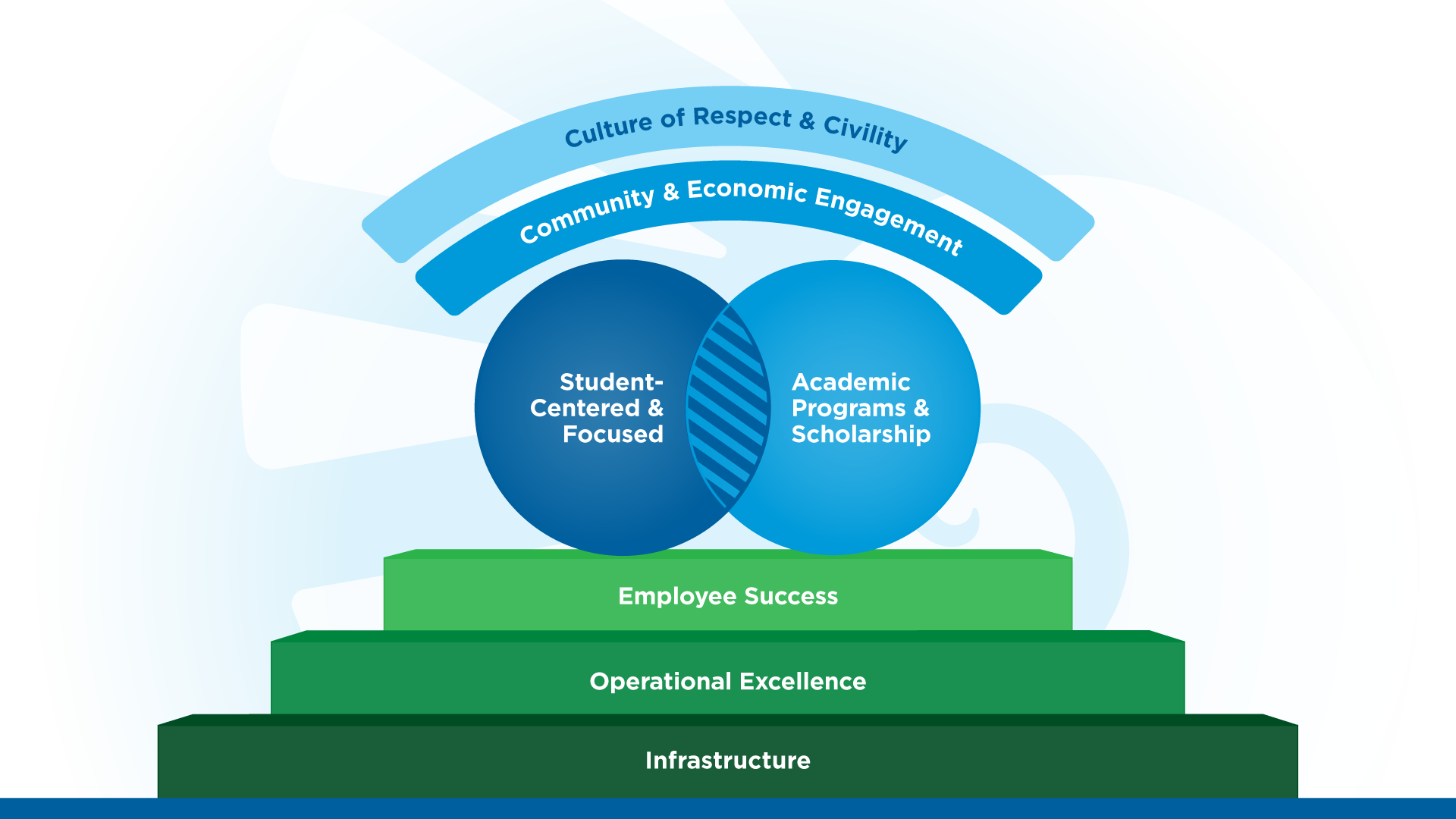
Since opening its doors to students in the fall of 1967, the University of West Florida has grown from its beginnings as a senior-level institution of higher learning to a comprehensive regional university recognized nationally for academics, athletics, and employee satisfaction. UWF is ranked in the top 20 public universities in the South by U.S. News and World Report with special recognitions for social mobility, veterans’ services and undergraduate nursing.
Recent programming has allowed the University to combine the strengths of the institution with the strengths of the region. An example lies in the development of the Ph.D. in Intelligent Systems and Robotics, a successful collaboration between UWF and the Institute for Human and Machine Cognition. UWF’s cybersecurity programs are strongly aligned with the Information Warfare Training Command at Corry Station in Pensacola, the National Security Agency, and the State of Florida.
COVID-19 has altered the way we think about teaching and learning, and how we manage the University. We see the need to carefully balance online with traditional face-to-face teaching and support. We have also learned that not all employees need to be physically on campus all the time to effectively perform their duties. This shift in perspective has added texture to UWF’s Strategic Plan 2022-2027.
Mission
UWF delivers a learner-focused university education that enables students from varied backgrounds to meet their career and life goals. UWF research and community partnerships advance the body of knowledge and enhance the prosperity of the region and the state.
President’s Vision
“A fully engaged university recognized for the strength of our graduates, responsiveness to the needs of the state, and an unrelenting competitive spirit.” - Dr. Martha D. Saunders, 6th President
Values
Integrity: UWF operates with fairness, respect, and integrity in all matters: Doing the right thing for the right reason.
Innovation: UWF expands learning as well as knowledge through creating and embracing opportunities for transformational change.
Caring: UWF is student-centered, crafting a safe, healthy, sustainable, dynamic learning and working environment that fosters individual potential.
Engaging: UWF promotes a culture of collaboration, cooperation, communication, commitment, and engagement to accomplish shared goals.
Accessible: UWF is committed to providing accessible resources and opportunities for all individuals.
Respect: UWF is appreciative and respectful of the diversity among all people and their ideas.
Strategic Directions
| Goals | Indicators of Success |
|---|---|
| Goal 1.1 Provide high impact educational and co-curricular learning experiences that inspire, engage, and prepare students to become knowledgeable citizens and successful in their careers and lives. |
|
| Goal 1.2 Student recruitment and retention programming aligned with the University’s strategic enrollment plan. |
|
| Goal 1.3 Adequate physical and virtual learning support opportunities for earning degrees and related credentials, including post-graduation. |
|
| Goal 1.4 Student awareness of available resources for support. |
|
| Goals | Indicators of Success |
|---|---|
|
Goal 2.1 Recruit and retain capable employees who support UWF’s mission, values, and strategic directions of service to the institution and the community. |
|
| Goal 2.2 Provide adequate workforce flexibility to address market needs and demands. |
|
| Goals | Indicators of Success |
|---|---|
| Goal 3.1 Ensure excellent academic programs in areas of strategic importance to the University, region, and state. |
|
| Goal 3.2 Enhanced student-faculty engagement. |
|
| Goals | Indicators of Success |
|---|---|
| Goal 4.1 Enhance the region’s educational opportunities, economic development, health, and environmental sustainability. |
|
| Goal 4.2 Provide specific workforce needs/credentials for regional and state businesses. |
|
| Goal 4.3 Ensure mutually beneficial, highly visible cultural, entertainment and recreational events. |
|
| Goals | Indicators of Success |
|---|---|
| Goal 5.1 Safe, effective, efficient use of physical plant. |
|
| Goal 5.2 Maintain up-to-date technology. |
|
| Goal 5.3 Establish UWF as desirable destination for educational, cultural, recreational, and professional events for the community. |
|
| Goal 5.4 Manage UWF’s natural resources to improve utilization, resilience, and environmental sustainability. |
|
| Goals | Indicators of Success |
|---|---|
| Goal 6.1 Effective and timely business and operational services informed by best practices. |
|
| Goal 6.2 Ensure student and employee safety and continuity of operations from natural disasters or catastrophic events. |
|
| Goal 6.3 Assure accountability of operations and outcomes to appropriate internal and external stakeholders. |
|
| Goals | Indicators of Success |
|---|---|
| Goal 7.1 Maintain a welcoming and respectful environment for employees, students, visitors and service partners |
|
| Goal 7.2 Ensure a commitment to openminded and tolerant civil discourse. |
|
| SUS Goals | Excellence | UWF Goals | Productivity | UWF Goals | Strategic Priorities | UWF Goals |
|---|---|---|---|---|---|---|
| Teaching & Learning | Strengthen Quality & Reputation of Academic Programs & Universities | 1.2 3.2 |
Increase Degree Productivity and Program Efficiency | 1.1 1.2 1.3 |
Increase the Number of Degrees Awarded in STEM and other PSE | 3.1 |
| Scholarship Research, & Innovation | Strengthen Quality & Reputation of Scholarship, Research, and Innovation | 2.1 2.2 |
Increase Research and Commercialization Activity | 3.2 | Increase Collaboration and External Support for Research Activity | 3.1 |
| Community & Business Engagement | Strengthen Quality & Recognition of Commitment to Community and Business Engagement | 4.1 | Increase levels of community and business engagements | 4.1 4.3 5.3 |
Increase community and business workforce | 4.2 |
Steering Committee and Institutional Plan Feedback Group
| Representative | Organizational Unit |
|---|---|
| James Adams | Finance and Administration, Business & Auxiliary Services Office |
| Robert Dugan | Academic Affairs, Office of the Provost |
| Alycia Grieco | Staff Senate |
| Cindy Gruwell | Academic Affairs, Pace Library |
| Sharon Jordan | Office of the President |
| Dr. Ed Ranelli | External Affairs |
| Dr. Sherry Schneider | Faculty Senate |
| Dr. Allison Schwartz | Academic Affairs, Office of Undergraduate Research |
| Patti Spaniola | Academic Affairs, Office of the Provost, and Conferences and Events |
| Representative | Organizational Unit |
|---|---|
| Dr. Mohamed Khabou | Hal Marcus College of Science and Engineering, Electrical and Computer Engineering Department and Office of the Dean |
| Jason Crawford | College of Business, Consultant to the Office of the Dean |
| Dr. Charlie Penrod | College of Education and Professional Studies, Administration and Law |
| April Harvey | Human Resources |
| Sandra Thompson | Information Technology Services, IT Operations |
| Sheyna Marcey | UWF Historic Trust |
| Dave Scott | Intercollegiate Athletics |
| Dr. Angela Bryan | Academic Affairs, Institutional Effectiveness |
| Dr. Matt Schwartz | Research Administration |
| Dr. Tom Gilbar | UWF at Emerald Coast Campus, Department of Electrical and Computer Engineering |
In Appreciation
The committee wishes to thank the students of Dr. Sherry Schneider’s SOP 6668 Organizational Change and Development graduate course who provided invaluable help. Course members attended the open meetings as note takers; they reviewed and organized (coded) the survey submissions; and, they submitted a report analyzing the survey data and made recommendations for consideration of changes for the new plan.
For use in media and presentations: Strategic Plan Graphics