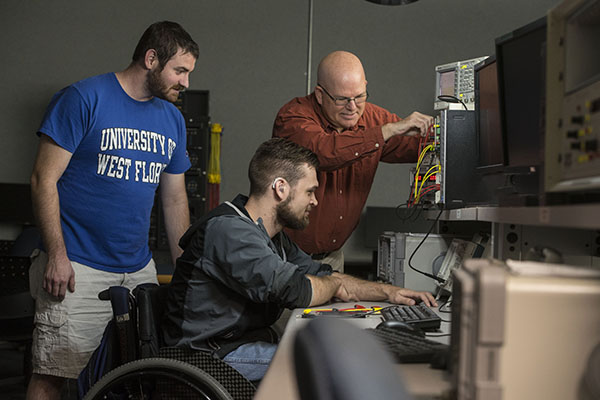
The Bachelor of Science in Civil Engineering equips students with the technical knowledge, hands-on experience, and leadership skills needed to launch a successful career in civil engineering or pursue advanced graduate studies. Program graduates will be prepared to make a lasting impact on the world through infrastructure innovation.
Why Study Civil Engineering at UWF?
At UWF, civil engineering students benefit from personalized attention, flexible course options, and access to state-of-the-art facilities at both the Pensacola campus and UWF Emerald Coast. The program emphasizes one-on-one interaction with expert faculty and encourages interdisciplinary exploration across multiple engineering fields.
Through a thoughtfully designed curriculum, students gain a solid foundation in mathematics, physics, mechanics, and materials science, while also diving deep into civil engineering principles. The program allows students to tailor their studies to areas such as structural engineering, geotechnical and soil mechanics, environmental engineering, water resources and hydraulics, and transportation and highway design.
With Northwest Florida’s strong military and industrial presence and civil engineering jobs projected to grow in the region, opportunities for program graduates are abundant.
What You Will Learn
Civil engineering at UWF is about more than theory—it’s about real-world application. You will learn how to:
- Design critical infrastructure including buildings, bridges, highways, dams, airports, and water systems.
- Plan and oversee construction projects with a focus on safety, efficiency, and sustainability.
- Study soil behavior and foundation systems to ensure structural stability.
- Develop technical skills in tools such as AutoCAD, GIS, and structural modeling software.
- Solve complex engineering problems with innovative thinking and practical approaches.
- Communicate effectively with multidisciplinary teams, clients, and the public.
Whether planning the next transportation hub, designing sustainable water systems, or improving community resilience through smart infrastructure, you will be prepared to lead and excel in the early stages of your civil engineering career.
As a graduate of the UWF civil engineering program, you will leave UWF ready to contribute to the evolving challenges of the built environment, equipped with the technical expertise, leadership ability, and ethical foundation expected of tomorrow’s civil engineers.
UWF offers classes through various delivery methods, including face-to-face, hybrid, and online. Though UWF makes every effort to provide on-campus classes in face-to-face programs, there is a possibility that some classes will have limited availability and may be offered online only. For more information, review the modes of delivery and instructional methods.