


Your Product Won't Win You Customers. Your Brand Idea Will. Here's How to Unearth It.
Branding—no matter how creative or well executed—cannot create an authentic Brand connection on its own.
By Richard D. Czerniawski
In the Spring 2026 Bear Business Solutions article, "Brand vs. Branding: Why This Distinction Determines Marketing Success," we explored the strategic difference between a Brand and branding. A Brand is the special bond and relationship an organization develops with its target customers. It is built on shared values, meaningful experiences, and a consistently fulfilled promise. Branding is how that promise is expressed through every customer touchpoint.
The distinction matters because branding—no matter how creative or well executed—cannot create an authentic Brand connection on its own. The kind of connection that drives customer preference and Brand loyalty begins with a sound Brand Positioning Strategy (BPS)—the strategic blueprint that defines the Brand’s strategic intent, its unique reason-for-being, and directs every branding decision that follows. That naturally raises an important question: Where does a winning Brand Positioning Strategy begin? Many organizations begin with the product
or service. They compare features, functions, performance, quality, and price, searching for meaningful points of difference. Yet we compete in what might best be described as an “age of abundance and sameness.” Across industries, competitors increasingly perform similar functions, solve similar problems, and deliver similar outcomes. When meaningful prod-
uct differences emerge, fast-following competitors often imitate them, quickly eroding any competitive advantage. Consequently, many organizations find themselves developing positioning strategies for products rather than Brands. Others mistake positioning for advertising, using it only to shape messaging rather than to guide the development
of the Brand itself. Still others have never documented a Brand Positioning Strategy at all, relying instead on instinct, tradition, or competitive reaction to guide marketing decisions.
The result is predictable. Marketing becomes a series of disconnected activities rather than a disciplined effort to build customer preference and Brand loyalty.
Building a winning Brand Positioning Strategy requires beginning in a different place. It begins with unearthing a Brand Idea.
THE BRAND IDEA
The Brand Idea is not a slogan. It is not an advertising campaign, a mission statement, or simply another product benefit. Rather, it captures the relevant, meaningfully differentiated meaning the Brand will ultimately represent in the minds of its target customers. The Brand Idea does far more than differentiate a product. It becomes the organizing principle for developing a Competitive Brand Positioning Strategy, informing every important marketing decision that follows. Without a clearly articulated Brand Idea, organizations often find themselves reacting to competitors, pursuing disconnected initiatives, or relying on promotion to compensate for the absence of strategic direction.
- Positioning transforms products into Brands.
- Without meaningful differentiation, products inevitably become commodities.
- People rarely become loyal to products alone.
- Products satisfy functional needs.
- Brands represent something customers value, believe in, and identify with. Customers may purchase a product because of what it does, but they become loyal to a Brand because of what it represents. That distinction is profound.
The challenge, then, is not simply identifying another product benefit. It is unearthing a Brand Idea capable of creating meaningful differentiation and attracting customers who believe in and seek what the Brand represents. Where should marketers begin looking? The answer lies in understanding the Whole Product.

THE WHOLE EGG OR EGG WHITES?
I love eggs. I eat them every day—sometimes twice a day. But I confess: my love of eggs is conditional. I love fried eggs, provided they’re prepared over-easy. I’m fine with scrambled eggs, but I prefer omelets. I’m not particularly fond of hardboiled eggs, yet I thoroughly enjoy my wife’s deviled eggs. What I find most perplexing are those people who eat only egg whites
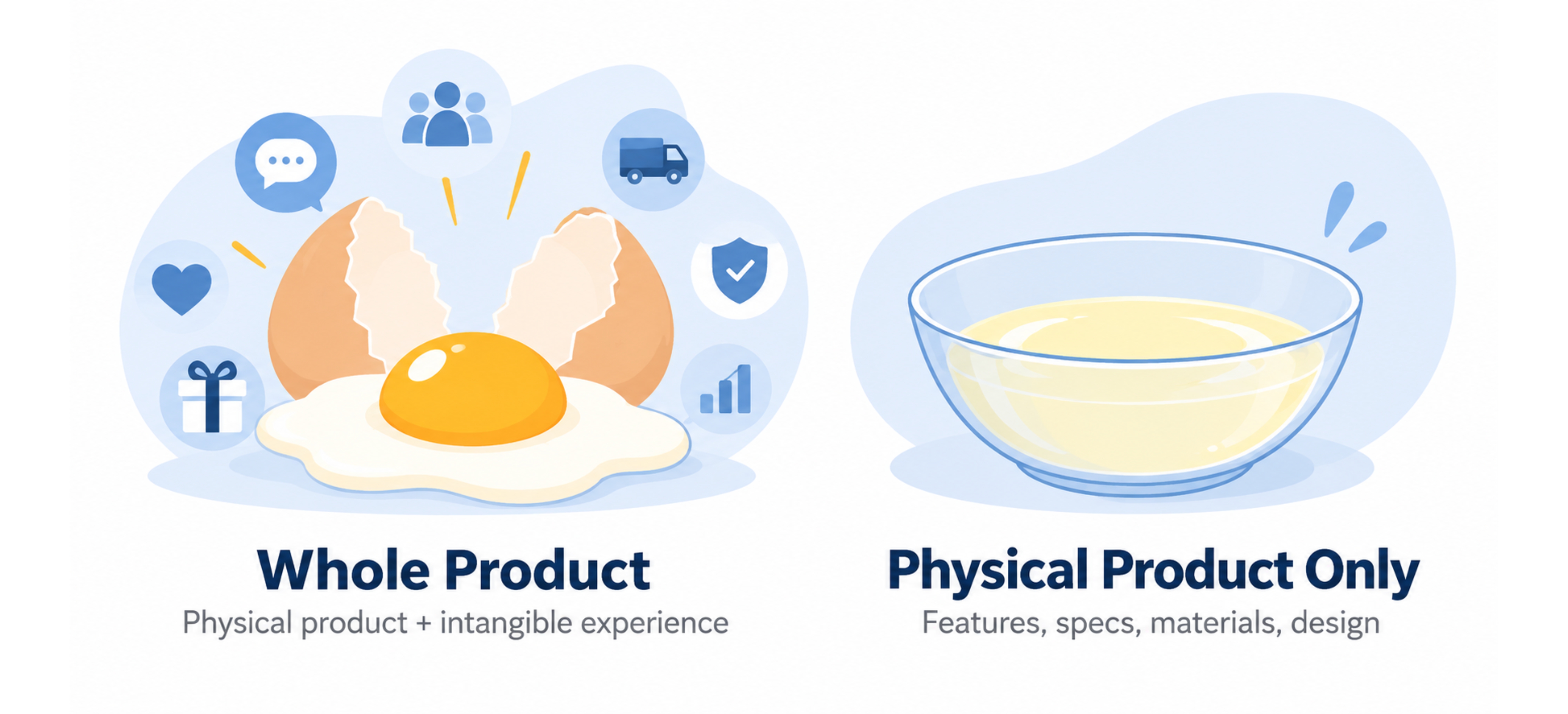
while ignoring the yolk. They’re missing a lot. The whole egg tastes better. It provides a richer experience. More importantly, most of the nutritional value resides in the yolk. Brands work the same way. Too many organizations focus exclusively on the “egg white”—the physical product—while neglecting everything else that shapes the customer experience.
The physical product consists of features, specifications, ingredients, materials, design, technology. and packaging. Research & Development creates these tangible elements.
But the Whole Product includes much more.
It also encompasses the intangible elements surrounding the product: customer service, warran-ties, financing, onboarding, training, delivery. return policies, technical support, digital experiences, loyalty programs, communities, guarantees, and every interaction customers have before, during. and after purchase These intangibles don't come out of the factory. Yet they often determine Brand preference. in fact, the most successful Brands recognize that customers rarely buy products alone. They buy complete experiences.
THE WHOLE PRODUCT EXAMPLE
Consider credit cards. Physically, an American Express Platinum Card looks remarkably similar to a Visa Infinite Card or a Mastercard World Elite Card. They are virtually identical in size and shape. They fit in the same wallet. They swipe, tap, and transact in essentially the same manner. From a purely functional standpoint, they perform the same basic job. Yet many customers—such as me—willingly pay a substantial annual fee for the American Express Platinum Card. Why? Because target customers are not simply buying a payment mechanism. That's table stakes, or the cost of entry. They are buying a Whole Product that goes beyond the physical card to encompass everything that supports the cardmember's experience.
American Express surrounds its physical card with a rich ecosystem of intangible benefits: concierge services, airport lounge access, travel protections, hotel privileges, purchase protection, dispute resolution, premium customer service, exclusive experiences, rewards programs, and personalized treatment.
When my card has been compromised, American Express has overnighted a replacement wherever I happened to be. When I've experienced legitimate issues with merchants, Amex has frequently intervened on my behalf. Their customer-service representatives consistently treat me, and all its cardmembers, with professionalism and respect.
The physical card may look no different from competing cards. The Whole Product I experience is very different—and for target customers like me, those differences matter. The same principle applies across industries. Here are a few notable examples of Whole Products:
Apple—More than smartphones, Apple offers seamless integration across devices, Genius Bar support, software updates, security, ecosystem compatibility, and a user experience that reduces friction.
Volvo—Leadership in occupant protection, collision avoidance, structural engineering, driver assistance technologies, dealer support, and an unwavering commitment to automotive safety.
Nike—Performance innovation, elite athlete partnerships, digital coaching, community, competition, and continuous improvement. In each instance, the Brand’s competitive advantage extends far beyond the physical product to the intangibles that help make up the Whole Product.
BUILD YOUR BRAND IDEA FROM THE WHOLE PRODUCT
The Whole Product reveals where customer value is created. The Brand Idea captures what that value ultimately means to the customer. If your Brand Idea is based solely on product features, you’re probably leaving significant value on the table. You’re creating a product, not a Brand Positioning Strategy. And it’s not going to win you customers. Some of your most meaningful points of differentiation may reside in the intangibles—the experiences, services, and relationships that evoke deep emotional benefits and become part of your Brand’s identity.
Your Brand Idea should emerge from the Whole Product because customers experience the Whole Product. If your Whole Product is inferior to your competitors’, get to work building it up.
Discovering the Brand Idea should not only inform development of the Brand Positioning Strategy. It should also inspire continual improvement of the Whole Product itself.
Understanding the Whole Product, however, is only the beginning. The Whole Product identifies where value exists. It does not reveal what that value ultimately means to customers. That requires discovering customer insight. Discovering those insights is the bridge between the Whole Product and a winning Brand Idea.
DISCOVERING A CUSTOMER INSIGHT TO UNEARTH MEANING FROM THE WHOLE PRODUCT
Creating a winning Brand Idea requires a deep understanding of the Whole Product, the customer, the competition, and the marketplace. Only then can we discover insights that reveal our true value and provide the relevant, meaningful differentiation necessary to drive customer preference. To accomplish this, I often ask a series of questions of each business team member—going beyond marketing to include R&D, Legal, Marketing Research, Operations, Clinical, Sales, and more— who is responsible for developing the Brand Idea and Competitive Brand Positioning Strategy.
These questions are not intended to generate hard answers. They are intended to provoke insights. The answers often reveal hidden meanings within the Whole Product that competitors overlook—where the Brand can win customers and cement Brand loyalty. The insights often reveal opportunities for differentiation—sources of competitive advantage.
Here are six of the questions I use to unearth winning Brand Ideas that lead to the development of a Competitive BPS that drives customer preference and creates Brand loyalty:
- On a scale of one to ten—with no one allowed to choose seven—how excited are you about your offering (i.e., product, device, molecule, service, whatever)? More important than the number is the explanation. The discussion often reveals what team members genuinely believe is special about the offering, what customer needs it addresses, and how it compares with current and anticipated alternatives. The degree of excitement frequently reveals insight. The lack of excitement suggests that more thinking or work is needed on the Whole Product.
- What would the world miss if this offering never existed? Or, for an existing offering, what would customers miss if it disappeared tomorrow? This question gets to the heart of relevant, meaningful differentiation. If customers would struggle to identify what they would miss, the offering may lack meaningful distinction. Again, think deeper and return to the Whole Product. If they would miss it, why? The answer to “why” often reveals the value we need to leverage to win in our “age of abundance and sameness.”
- Is there a “WOW”? If so, what is it? Every successful Brand should possess something capable of capturing customers’ interest. It may be superior performance. It may be a breakthrough innovation. It may be a unique customer experience. It may even be a particular aspect of the Whole Product. The challenge is identifying the single most compelling reason customers should be wowed by your offering.
- Who do you perceive as your competitors? Understanding the competition is not merely about identifying rivals. It is about understanding their strengths, weaknesses, vulnerabilities, and future intentions. It is also about identifying areas where we might win—drawing attention to what your offering does differently or better. Competitive weakness often serves as a beacon that illuminates our offering’s strength.
- Who is the “bull’s-eye” target customer? Nothing—absolutely nothing—is for everyone. The strongest Brand Ideas are built around a clear understanding of the customer most likely to respond. These are people who are dissatisfied—or who may not yet realize they should be dissatisfied—with available alternatives. The clearer the target, the stronger the Brand Idea.
- How do you want customers to think about your offering? Complete this sentence: “X is the only one that ________.” This simple exercise forces clarity. It is intended to reveal the value proposition, the source of differentiation, and the unique place the offering can occupy in the customer’s mind, heart, and soul. If the statement can be completed convincingly and credibly, the foundation of a Brand Idea is often close at hand. If it cannot, more work remains.
The purpose of these questions is not to generate more data, but to spur creativity.
The answers help uncover what makes an offering relevant, meaningful, and different in ways customers value and competitors struggle to match. That understanding—and the creativity that springs from it—becomes the foundation of a winning Brand Idea.
Here are two “inferred” notable examples moving from the Whole Product to Customer Insight to Brand Idea:
Volvo
Whole Product — Leadership in occupant protection, collision avoidance, structural engineering, driver-assistance technologies, dealer support, and an unwavering commitment to automotive safety. Customer Insight —Parents don’t simply buy safer automobiles. They want confidence that they have done everything possible to protect the people they love most. Brand Idea — Unparalleled safety to protect the people who matter most.
Nike
Whole Product — Performance innovation, elite athlete partnerships, digital coaching, community, competition, and continuous improvement. Customer Insight —People don’t simply buy athletic shoes and apparel. They aspire to become stronger, healthier, faster, and a better version of themselves. Brand Idea — Unlocking the athlete within.
STRATEGIC QUESTIONS FOR (THOSE WHO ASPIRE TO BECOME) BUSINESS LEADERS
- If competitors duplicated your physical product tomorrow, what would remain distinctive and difficult to imitate?
- Are you defining your product too narrowly? If you’re focused solely on physical features and attributes, you probably are.
- What intangible elements accompany your offering? More importantly, which of these truly create value for target customers?
- Are those intangible elements of your offering truly unique, or merely the cost of entry?
- What experiences occur before, during, and after purchase? Are they reinforcing—or undermining—your Brand Idea?
- Are you serving up the Whole Product—or merely the egg whites?
- What are you doing to discover customer insights that unearth the meaning inherent in your Whole Product and customers’ experience with it?
- What is your distinctive Brand Idea, and how does it inform your Brand Positioning Strategy?
APPLYING THESE PRINCIPLES AND PRACTICES TO YOUR BUSINESS
- Define your Whole Product. Identify every tangible and intangible element customers experience.
- Benchmark your Whole Product against your key competitor. Identify where you have a distinct competitive advantage.
- Strengthen the elements customers value most. If your Whole Product fails to match well against your competitor’s, build on it. Get beyond the cost- of-entry tangible and intangible aspects of the product.
- Dig, dig, dig to discover a customer insight that unearths the meaning inherent in your Brand—the meaning that differentiates it from both the product category and competitive Brands.
- Identify several potential Brand Ideas. Treat each as a hypothesis.
- Validate which meaning resonates most strongly with your target customer and use it as the foundation of your Brand Positioning Strategy.
The Whole Product reveals where customer value—and competitive advantage—is created. Customer insight uncovers what that value ultimately means to customers. The Brand Idea captures that meaning. And the Brand Positioning Strategy transforms that meaning into a Brand customers prefer, believe in, and remain loyal to. It takes discipline, deep understanding of your offering, and creative strategic thinking. But that’s what it takes to become a leadership Brand.
BUILDING STRATEGIC MARKETING CAPABILITY
For Northwest Florida business leaders seeking to develop strategically sound brand positioning strategies, the University of West Florida offers help: our marketing students apply sound strategic frameworks under the leadership of experienced marketing faculty in collaboration with you.
These collaborations benefit your business and our students: businesses gain a strategically sound Brand Positioning Strategy for a competitive advantage. Our students develop real-world marketing skills and business acumen in the process.
ABOUT THE AUTHOR
Richard D. Czerniawski, a Golden MBA (50th-anniversary graduate) from the University of West Florida, brings more than 50 years of global brand marketing experience with Fortune Top 100 companies, including Procter & Gamble, Johnson & Johnson, and Coca-Cola USA. His work spans 40 countries and more than 100 international cities, building iconic brands. He is Founder and President of Brand Development Network International, a global marketing resource company specializing in strategic brand development and competitive positioning. He is the author of three books and hundreds of articles on marketing management and serves as Adjunct Professor in Competitive Brand Positioning at the University of West Florida’s Lewis Bear Jr. College of Business.