


In the Wild: From Classroom to Community
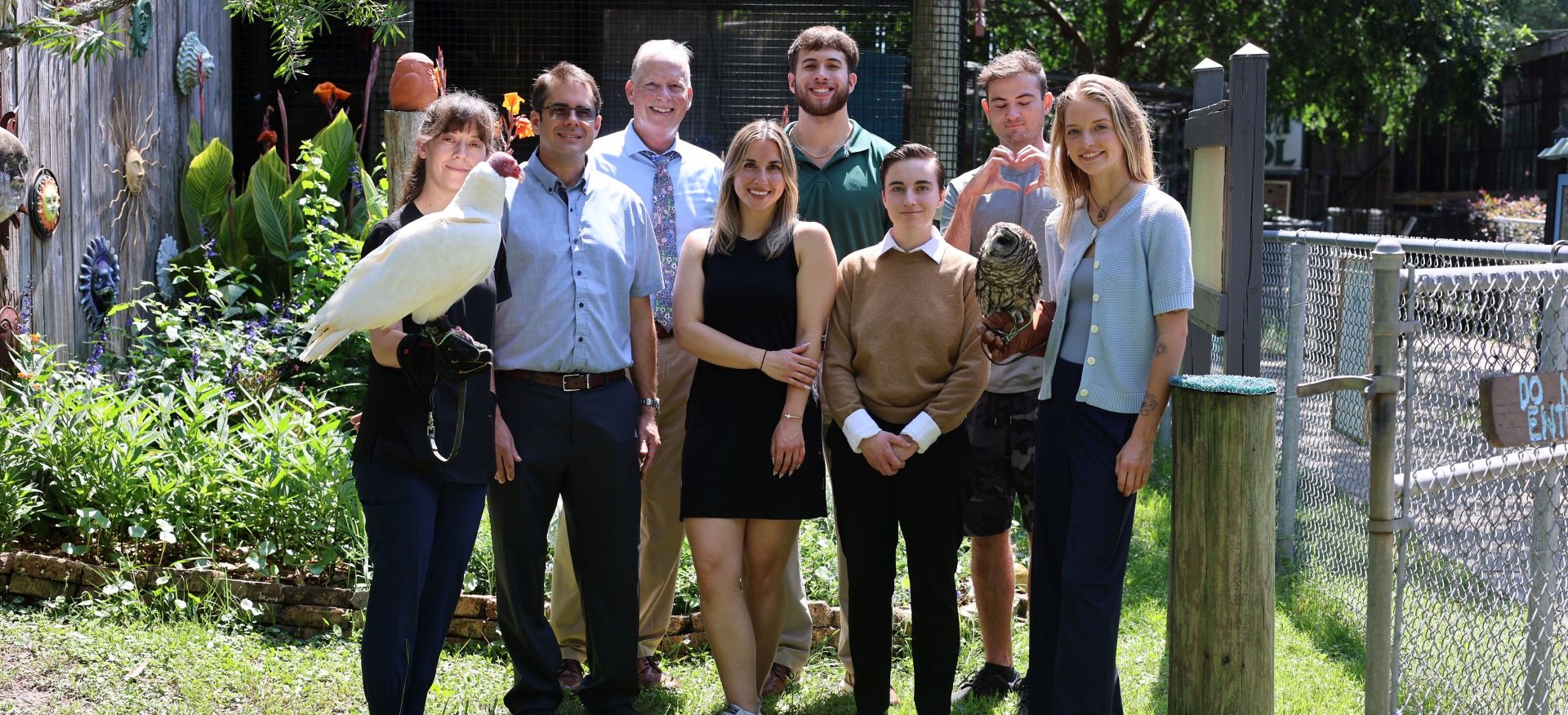
These projects give students functional experience in a specific context, with a real client, a real timeline, and consequences beyond a grade.
By James Mead
The Wildlife Sanctuary of Northwest Florida was founded more than four decades ago. Today. it is a nonprofit whose mission is to mobilize public, private, and human resources to provide care, create natural habitats, and promote wildlife preservation through education. It takes in injured and orphaned native wildlife from across the region and is among the few facilities in Florida permitted to rehabilitate bald eagles. Its permanent residents include Amelia, an eagle who arrived with a gunshot wound and cannot be released.
The organization has endured fires, hurricanes, and repeated floods. But flooding is not just an occasional inconvenience: it is a chronic threat. The Sanctuary sits in a flood-prone area, and when the water rises, it reaches the buildings where vulnerable animals are cared for, creating serious risks for the residents and the people responsible for them.
Relocation is a possible solution: a purpose-built wildlife hospital on higher ground, with facilities designed for the work the Sanctuary already does. Moving, however, requires a capital campaign on a scale the Sanctuary had never attempted. Before launching such an effort, an organization needs to know whether its community can support it. Feasibility studies are designed to answer that question, but professional firms charge accordingly, which can be difficult to justify when immediate resources are needed for animal care.
That is what made the project a live case. A live case asks students to work with a real business or community organization on a real problem inside the structure of a class. It is not a hypothetical exercise or a prepackaged assignment with a clear answer. It gives students hands-on experience as they develop the skills and judgment required to build and launch their careers, while the client receives analysis it can use for decisions that matter now.
WHAT THE STUDENTS DID
Asking a community whether it values and will support the growth of a nonprofit sounds simple. Doing it in a way that produces solid data leading to actionable results is not.
Reaching beyond the usual supporters. The students began with the Sanctuary's known audience. The organization supplied its email list and social media channels, which gave the class a direct way to reach current donors, former donors, and prospects who already had some connection to the organization. But that group alone could not answer the larger question. A capital campaign also depends on whether the broader community understands, values, and might support the Sanctuary's work.
To reach that public, the students randomly selected households across Escambia and Santa Rosa counties and mailed physical postcards with QR codes linking to the survey. They also used a representative email list to broaden data collection among residents more likely to respond online than by mail. Taken together, those channels gave the class the right mix of known supporters, former donors, and community residents to produce data the Sanctuary could actually use to judge campaign feasibility.
Asking better questions. People say yes to a general "would you give?" question far more often than they open their wallets, especially when the cause is worthy. The students needed a way to measure giving that more closely reflected a real fundraising decision. The survey used an adaptive approach: each respondent was shown a specific donation amount, with the starting amount randomly assigned so the class could observe a wider range of possible giving levels. If a respondent said yes, the survey moved to a higher amount; if the respondent said no, it moved to a lower one. That design helped estimate not just whether people supported the Sanctuary's future. but how much different groups might realistically be willing and able to contribute.
The students then compared those survey responses with the Sanctuary's historic giving records, using past behavior to test whether stated intentions lined up with actual donor patterns. They largely did.
The results also showed meaningful differences across segments: some respondents appeared willing to give substantially, while others were more likely to support the Sanctuary through volunteering or other forms of engagement, especially when household budgets were tight. Coupled with segmentation analysis, the adaptive giving question gave the class a clearer view of who could give, who wanted to help in other ways, and how the Sanctuary might build a campaign around both kinds of support.
Testing the message instead of guessing. The Sanctuary had several credible ways to tell its story, but the students needed to know which one would actually move people. Rather than debating the strongest appeal, they built an experiment. Each respondent was randomly shown one of three messages: "Amelia's Story," a rescued eagle's account; "A Center for You," a community-benefit frame; and "Buy 1 Square Foot of Dry Ground," which focused on moving the facility out of the flood zone. No one saw more than one. Because the assignment was random, differences in response could be attributed to the message itself rather than to differences among the people reading it. That is the same method behind a well-run clinical trial, applied to marketing research.
The data showed that all three messages were reasonably strong, but the most powerful tested appeal was Amelia's Story. Her journey made the Sanctuary's purpose concrete. It carried emotional resonance because it showed what the organization is designed to do: rehabilitate wildlife and, when possible, return animals to the wild.
It also showed why the work is more complicated than that promise sounds, because not every animal can be released. Amelia's story made the need for the Sanctuary personal, specific, and difficult to dismiss, and the data confirmed that this was the strongest approach to communicate the Sanctuary's value to the community.
Turning data into direction. Finally, the students used statistical analysis to separate the factors that actually predict giving from the ones that merely look like they should. The analysis also showed that the community was not one audience with one set of motivations. Different groups of respondents valued and responded to different parts of the Sanctuary's work: some were moved most by individual animal stories, others by the organization's regional role, and others by practical questions about future facilities, flooding, and long-term capacity.
That mattered because the question was never only whether people supported the Sanctuary; it was whether the Sanctuary had the right data to understand who was likely to give, who might support the work in other ways, and what each group needed to hear before taking action.
Reporting those differences gave the Sanctuary a more strategic path forward. Instead of using one broad message for everyone, it could communicate more deliberately about what the Sanctuary does, why it matters, and how each audience's values connect to the fundraising and operational needs of the organization's future.
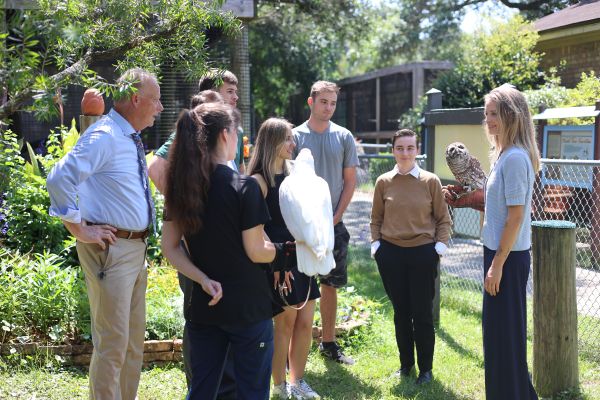
BUILDING JUDGMENT
Information is now effectively free. A student with an AI assistant can generate a literature review, a survey draft, or a plausible-looking analysis in minutes. Some of it will be correct and useful.
Some of it will be wrong (in a way that sounds plausible). That changes what business education should emphasize. If people can access topic-specific information almost instantly. the higher-value work is no longer simply knowing what the information says. It is knowing how to use it, when to trust it, and how to use it to move forward.
It is one thing to know what a feasibility study, a sampling plan, or a message test is in theory; it is another to execute all of it together, for a client that has to make decisions based on the results.
The students had to move from information to practice: building a sampling frame beyond the Sanctuary's email list, mailing postcards and waiting for responses, managing a messy dataset, and deciding which findings were solid enough to put before a board.
That is where judgment develops. These projects give students functional experience in a specific context, with a real client, a real timeline, and consequences beyond a grade. They learn not only how to produce an answer, but how to decide what the answer can responsibly claim. That is the learning business education should prioritize: not just imparting knowledge, but developing the skills and judgment students can carry into their future careers.
WHAT IT CHANGED
The Sanctuary entered the engagement believing its community cared about its mission, but without the evidence needed to prove it, price it, or plan around it. It exited with a professional-quality deliverable tied directly to decisions the organization had to make in the moment: whether a capital campaign was feasible, which audiences were most likely to support it, what messages those audiences responded to, and how the organization should communicate its need for a safer future facility.
The Sanctuary has since launched its capital campaign and applied for grant funding toward the relocation. As Leah Schultz, development coordinator at The Wildlife Sanctuary of Northwest Florida, told the UWF Newsroom, "The feasibility study has already been used in meetings when discussing relocation with various partners to show that we are desired and supported by the community from a financial perspective. Proving that we, as an organization, have a mission that our community believes in will be highly important moving forward."
For students, the value was just as concrete. They did not work from a purpose-built textbook dataset designed to behave cleanly. They conducted real marketing research for a real client. That guided, hands-on experience gave them a stronger way to talk about their skills and a professional-quality deliverable they can reference when applying for jobs and internships.
That matters because marketing research can be a hard field to break into without evidence of applied experience. Students from this class can now describe an engagement they helped carry from sampling design through final recommendation, and they can show how their work informed an actual organization's fundraising and operational decisions. Whether they pursue marketing research as a career focus or use research skills inside another organization, they leave with evidence that they know how to move from data collection to usable strategy
Ashley Alexander, one of the students in the class, shows how a live case can continue to matter long after the semester ends. After working on the project as an undergraduate, she became a long-term intern with the Sanctuary, running social media outreach, supporting donor engagement, and contributing to grant writing. In that role, she is now putting her team's recommendations into daily practice: telling the Sanctuary's story on the channels supporters actually watch, reducing friction for first-time gifts, and focusing on the kinds of engagement most strongly linked to giving. She is not executing someone else's strategy; she is helping carry forward the strategy her team built.
OUR MISSION THROUGH LIVE CASES
Projects like this show how the Lewis Bear Jr. College of Business can deliver on its mission through live cases. Students build individual prosperity by doing consequential work before they graduate, developing the skills, judgment, and professional confidence they will carry into their careers and lives. Community organizations gain analysis they could not easily produce on their own, tied to real decisions they need to make now.
The region benefits when those organizations become stronger, more resilient, and better equipped to serve the people and places around them.
The Wildlife Sanctuary project is one example among many. Across the College, live cases connect classroom learning to the needs of businesses, nonprofits, and regional partners. They produce more than assignments. They create impactful work, build student careers, strengthen organizations, and extend the College's impact across Northwest Florida. You can learn more about the Wildlife Sanctuary at pensacolawildlife.com.
ABOUT THE AUTHOR
James A. Mead is Chair of the Department of Commerce in the Lewis Bear Jr. College of Business and a Professor at the University of West Florida. He earned his Ph.D. from the University of Kentucky. His research centers on consumer emotion and memory. He teaches marketing, and his work appears in leading business and marketing journals. His industry experience includes serving as a senior market research analyst, specializing in product development, advertising, branding, and customer experience.