


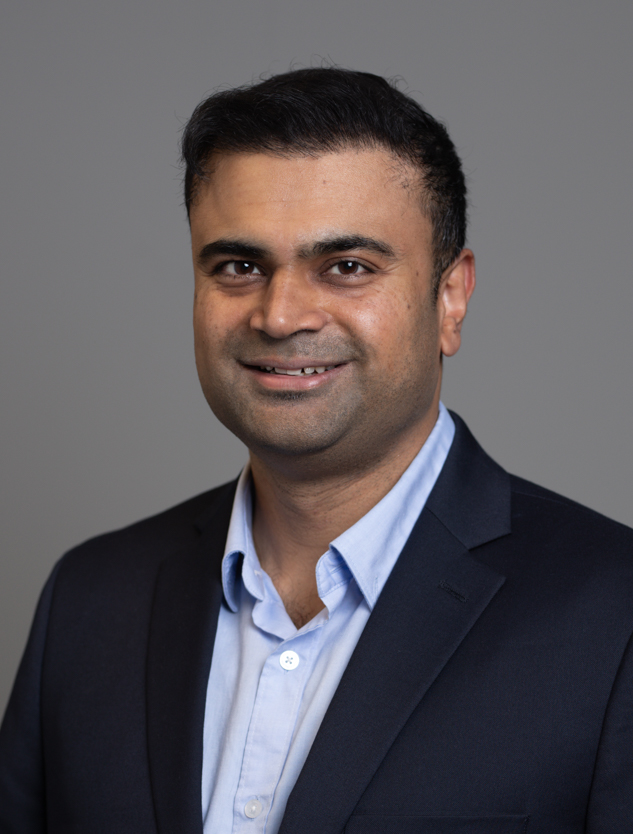
Dr. Nikhil Vishwas Divekar
- Position: Assistant Professor
- Department: Intelligent Systems and Robotics
- Office Location: Building 4, Room 243
- ndivekar@uwf.edu
- Campus: 850.474.2963
- LinkedIn Profile
Biography
Dr. Nikhil Divekar is an Assistant Professor in the Department of Intelligent Systems and Robotics at the University of West Florida, within the joint doctoral program with the Florida Institute for Human and Machine Cognition (IHMC). His research interests lie at the intersection of neurophysiology, biomechanics, and robotics, with a focus on the mechanical design and control of wearable and assistive robots, including exoskeletons and prostheses.
He earned his Ph.D. in Robotics from the University of Michigan in 2023 and subsequently conducted postdoctoral research in the Locomotor Control Systems Laboratory under Professor Robert D. Gregg. Previously, he served as a Research Officer in Biomechanics in the Division of Exercise Science and Sports Medicine at the University of Cape Town. His interdisciplinary training spans mechatronics, biomedical engineering, bioengineering, and robotics.
Dr. Divekar’s experience includes investigations of neural control and muscle coordination, biomechanical analysis of human movement, and the development and experimental evaluation of assistive robotic systems. A central theme of his work is the development of interpretable, biomechanics-informed controllers that complement voluntary movement across diverse activities and terrains. His research aims to use machine learning to accelerate the customization of robotic assistance while preserving a biomechanically interpretable control framework.
His work published in Science Robotics demonstrated a versatile knee exoskeleton that mitigates quadriceps fatigue during lifting, lowering, and carrying. His broader research includes personalized assistance for people with neuromuscular impairments, mobility support for older adults, and exoskeleton applications for osteoarthritis. Building on this work, he aims to advance wearable and prosthetic technologies for rehabilitation, everyday mobility, and occupational assistance.
Dr. Divekar is a co-inventor on two patent applications related to exoskeleton control and a co-recipient of the 2025 IEEE Transactions on Control Systems Technology Outstanding Paper Award. He has also received the T3N commercialization fellowship, Rackham Predoctoral Fellowship, and Jonsson Family Bioengineering Fellowship.
Degrees & Institutions
- Ph.D. Robotics, University of Michigan - Ann Arbor
- M.Sc. Robotics, University of Michigan - Ann Arbor
- M.Sc. Bioengineering, University of Texas at Dallas
- M.Sc. Biomedical Engineering, University of Cape Town
- B.Sc. Mechatronics, University of Cape Town
Research
Dr. Divekar’s research focuses on understanding human movement and developing wearable and assistive robots that restore or enhance physical function. His interests connect neurophysiology and biomechanics with mechanical design, control, and human–robot interaction. A central goal is to develop robotic assistance that complements voluntary movement across different activities, environments, and individual capabilities.
His mechanical design interests include optimizing the trade-off between device weight and power output in exoskeletons and prostheses, balancing the assistance a device can provide with the physical burden of wearing it.
His work also emphasizes biomechanics-informed control strategies whose behavior can be understood and customized using physical and physiological principles. Building on this foundation, he aims to use machine learning to accelerate the personalization of assistance while preserving a biomechanically interpretable control structure. His research combines device development with experimental and clinical evaluation to examine how assistance influences movement, muscle coordination, fatigue, and functional performance.
Applications include mobility assistance for older adults and people with neuromuscular or musculoskeletal impairments, as well as support during physically demanding work. His research interests encompass exoskeletons, powered prostheses, and other assistive technologies for clinical, occupational, and everyday use.
Specific research interests include:
- Neurophysiology and human motor control
- Human biomechanics and neuromuscular function
- Mechanical design and actuation of exoskeletons and prostheses, including optimization of weight–power trade-offs
- Biomechanics-informed control and machine learning for personalized assistance
- Physical human–robot interaction
- Experimental and clinical evaluation of assistive technologies
Special Interests
Dr. Divekar is interested in enhancing sports performance and motor learning through third-person visual feedback, allowing individuals to observe their movements from an external perspective. He also aims to investigate how this feedback, combined with robot-assisted movement guidance, can improve movement coordination and increase maximum running speed.
Publications
Journal Articles
Divekar, N. V., Thomas, G. C., Yerva, A. R., Frame, H. B., & Gregg, R. D. (2024). A Versatile Knee Exoskeleton Mitigates Quadriceps Fatigue in Lifting, Lowering, and Carrying Tasks. Science Robotics, 9(94), eadr8282.
Divekar, N. V., Baxter, A., & Gregg, R. D. (2025). Customizable Task-Agnostic Exoskeleton Control for Targeted Neuromuscular Assistance: Case Series. IEEE Open Journal of Engineering in Medicine and Biology, 6, 564–569.
Divekar, N. V., & John, L. R. (2013). Neurophysiological, Behavioral and Perceptual Differences Between Wrist Flexion and Extension Related to Sensorimotor Monitoring as Shown by Corticomuscular Coherence. Clinical Neurophysiology, 124(1), 136–147.
Conference Papers
Divekar, N. V.†, Hinojosa, E. H.†, Zhang, J., & Gregg, R. D. (2025). A Task-Agnostic Knee Exoskeleton for Reducing Osteoarthritis Pain Across Activities of Daily Life: A Pilot Study. IEEE International Conference on Rehabilitation Robotics (ICORR), 1437–1443.
Divekar, N. V., Lin, J., Nesler, C., Borboa, S., & Gregg, R. D. (2020). A Potential Energy Shaping Controller with Ground Reaction Force Feedback for a Multi-Activity Knee-Ankle Exoskeleton. 8th IEEE RAS/EMBS International Conference for Biomedical Robotics and Biomechatronics (BioRob), 997–1003.
Xu, P.†, Divekar, N. V.†, Zhang, J., & Gregg, R. D. (2026). Evaluation of TCN Variants for IMU-Based Foot Contact Detection Across Diverse Activities. IEEE Engineering in Medicine and Biology Society Annual International Conference (EMBC). Accepted.
† Shared first authorship.