


Living Lab
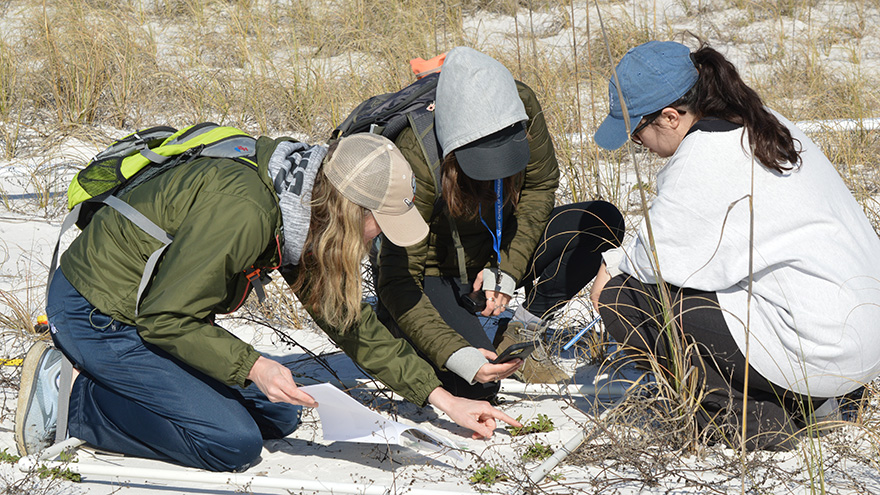
The UWF Living Lab, which launched in Fall 2024, brings researchers, learners and recreational enthusiasts together with a mission to understand and manage UWF Conservation areas. The UWF Living Lab is both the stage for activities and also the collaborative partnership between researchers, students, departments and the community. Through interdisciplinary research and cross-program activities and events, the UWF Living lab is a cultural, recreational, educational and research destination haven for our region.
What is a Living Lab?
Living labs have been established in many other higher education institutions and use real-world scenarios, such as management of a University’s sustainability practices, as teaching and research tools. The potential to use the UWF Conservation Areas as a research and teaching laboratory is endless, and the UWF Living Lab harnesses this potential by engaging researchers, students, and the community in these areas with academia and related projects.
Living Lab Grant Program
The Living Lab grant program supports and facilitates projects in the UWF Conservation Areas as a competitive funding opportunity. Members of the UWF community may submit proposals for projects through the UWF High Impact Practices funding application. These projects may be related to conservation, but it is not necessary for that to be their primary focus. Living Lab projects will enhance understanding of the UWF Conservation Areas in some way and/or foster a sense of connection between the community and these areas. Priority is given to projects that have sustainability or longevity.
Past Living Lab Grants
For examples of the types of projects supported by the Living Lab grant program, explore below to see those projects funded in Fall 2024. However, please note that we celebrate creativity and interdisciplinarity; proposals are not limited to these topics.
| Project | Summary | Departments |
|---|---|---|
| Blazing Trowels | Archaeological surveys of west campus to prepare for prescribed fire management. | Archaeology |
| Explore Trips | Bring 5th graders to campus and use West Campus as a laboratory for teaching about conservation and natural resources. | Biology, Continuing Education |
| From Soil to Soul | Using the installation of bat boxes in conservation areas to help teach about the importance of mindfulness and self care. | Usha Kundu, MD College of Health, School of Nursing, Nursing LLC, Earth and Environmental Sciences |
| Analysis of Foredune Environments | Using beach conservation area to teach data collection techniques—topographic surveys, vegetation surveys, and sediment analysis— along with statistical analysis techniques to students in both departments. | Earth and Environmental Sciences, Mathematics and Statistics |
| Poetry and Art Trail | Install 8 signs throughout west campus conservation areas with prompts leading to creative works submission by the community to a dedicated social media or website. | Creative Writing/English, Art and Design, broader UWF community |
| Antibiotic-Resistant Organisms Across the UWF Living Lab | Run a pilot study with undergraduate students with little research experience which will lead to a yearly electives course in biology and support an application for external funding for expanding the project. | Biology |