


VIPRA News
VIPRA News Archive
Paper on training AI/ML models on missing data without imputation: Blackthorn N, Mahyari AA, Srinivasan A. Training Variational Autoencoders for Population Synthesis in Public Health with Missing Data. Proceedings of the 2024 IEEE International Conference on Big Data (BigData) (pp. 4969-4973), (2024).
Paper on VIPRA Recommendation System: Coffey J, Pahle R, Srinivasan A, Namilae S, and Scotch M. A Knowledge Sharing Approach to Foster Interdisciplinary Pedestrian Dynamics and Epidemiological Modeling Research and Practice. Proceedings of the Ninth International Congress on Information and Communication Technology (ICICT), (2024).
HPC Wire article on mobility dataset for public health analysis: NERSC Helps Scientists Build Public Health Datasets from Location Services.
Paper on VIPRA recommender system: J. Coffey, R. Pahle, A. Srinivasan, S. Namilae, and M. Scotch. A Knowledge Sharing Approach to Foster Interdisciplinary Pedestrian Dynamics and Epidemiological Modeling Research and Practice. Proceedings of the Ninth International Congress on Information and Communication Technology (ICICT), (2024). (Accepted)
Data descriptor paper on crowd clusters in Florida and California during the COVID-19 pandemic: B. Swaminathan, J. Kang, K. Vaidya, A. Srinivasan, P. Kumar, S. Byna, and D. Barbarash. Crowd cluster data in the USA for analysis of human response to COVID-19 events and policies. Scientific Data 10:267 (2023).
VIPRA Research Assistant gets award: Nathan Farmer, a research assistant on the VIPRA project, received the Outstanding Undergraduate Student award in Computer Science from the University of West Florida.
Chapter in a book on "Architectural Factors for Infection and Disease Control": A. Srinivasan and S. Namilae. Infection Risk Mitigation Using Pedestrian Dynamics. A Chapter in Architectural Factors for Infection and Disease Control, Editors: A. Bliss and D. Kopec. Routledge, 2023.
Paper on effectiveness of masks on flights: S. Namilae, Y. Wu, A. Mubayi, A. Srinivasan, and M. Scotch. Identifying Mitigation Strategies for COVID-19 Superspreading on Flights using Models that Account for Passenger Movement. Travel Medicine and Infectious Disease 47 (2022): 102313.
Postdoctoral positions available: We have multiple postdoctoral positions available. Please see the following for further details:
- Postdoctoral Research Associate in Computer Science (position 494050)
- Postdoctoral Research Associate in Computer Science (position 494051)
- Research Positions
NSF SaTC funding: We have received a three-year grant from the National Science Foundation (NSF) for "Privacy Preserving Models Leveraging Mobility Data for Public Health".
NIH grant on a data analytics framework for public health: Project VIPRA has received a three-year grant from the National Institutes of Health (NLM) for “A data analytics framework for the application of pedestrian dynamics to public health”.
Three papers on methodologies for analyzing infection spread indoors:
- R. Löhner, H. Antil, A. Srinivasan, S. Idelsohn, and E. Onate. High-Fidelity Simulation of Pathogen Propagation, Transmission and Mitigation in the Built Environment. Arch. Computat. Methods Eng. (2021).
- Sadeghi Lahijani M, Gayatri R, Islam T, Srinivasan A, and Namilae S. Architecture-Aware Modeling of Pedestrian Dynamics. Journal of the Indian Institute of Science (2021).
- Derjany P, Namilae S, and Srinivasan A. Parameter Space Exploration in Pedestrian Queue Design to Mitigate Infectious Disease Spread. Journal of the Indian Institute of Science (2021).
Royal Society paper and media coverage: Royal Society Open Science published our paper pointing out infection risk arising from current airplane boarding policies. Islam T., Lahijani M. Sadeghi, Srinivasan A., Namilae S., Mubayi A. and Scotch M. 2021. From bad to worse: airline boarding changes in response to COVID-19. Royal Society Open Science. 8201019201019. It has received media coverage in several countries, such as Covid Risk Is Greater If Passengers Board Planes Back to Front and Back-to-front boarding ‘associated with greater risk of Covid-19 on planes’.
VIPRA included in a talk on software sustainability: VIPRA was included as a case study in a talk titled “Case Studies in Research Software Sustainability” by Rajiv Ramnath, The Ohio State University and Daniel Katz, University of Illinois at Urbana-Champaign in a panel at the SIAM Conference on Computational Science and Engineering, 2021.
Article suggesting N95 masks for the general public: Letters in Biomathematics published our editorial paper suggesting N95 mask use by the general public. Srinivasan A, Mubayi A, Akman O. (2020) Should N95 Respirators be Recommended for the General Public. Letters in Biomathematics, 7 (1), 143-152.
Bloomberg article on airline strategies for COVID-19: A Bloomberg article discussing questionable strategies used by airlines to deal with COVID-19 mentioned discussed VIPRA research: Airlines Stumble Ahead With COVID Plans That May Heighten Risks.
Associated Press article on COVID-19 spread in Florida: An Associated Press article discussed VIPRA research explaining the recent increase in COVID-19 in Florida: Study: Florida social interactions rose before virus spike.
PLoS ONE paper on mitigating infection risk in queues: PLOS ONE published our paper on mitigating infection risk in queues. Derjany P, Namilae S, Liu D, Srinivasan A (2020) Multiscale model for the optimal design of pedestrian queues to mitigate infectious disease spread. PLoS ONE 15(7): e0235891.
Daytona Beach airport uses insights from VIPRA: Prof. Sirish Namilae reviewed and provided guidance for COVID-19 emergency preparedness plan of Daytona Beach airport.
NSF grant on COVID-19: Project VIPRA has received a grant from the National Science Foundation’s RAPID program for “Leveraging New Data Sources to Analyze the Risk of COVID-19 in Crowded Locations”. This is in collaboration with the CAM2 team at Purdue.
PLOS ONE paper on CALM model: PLOS ONE published our paper on the new CALM model. M.S. Lahijani, T. Islam, A. Srinivasan, and S. Namilae. Constrained Linear Movement Model (CALM): Simulation of passenger movement in airplanes. PLoS ONE 15(3): e0229690 (2020).
Wired article on coronavirus mentions VIPRA: Wired magazine had a news article on In Planes and Trains, Mini-Mops and Fog Machines Battle Coronavirus that cited VIPRA research.
Press coverage related to coronavirus outbreak: The following news items discussed VIPRA research and the Workshop on Pedestrian Dynamics and Epidemic Modeling in the context of the current coronavirus outbreak.
- Contagion experts convene in Pensacola to discuss containing the coronavirus - Pensacola News Journal article quoting VIPRA researchers on the coronavirus outbreak.
- Coronavirus workshop: Experts gather at UWF to discuss air travel infections - WEAR TV (ABC affiliate) news on Workshop on Pedestrian Dynamics and Epidemic Modeling 2020.
- Experts to meet at University of West Florida to discuss coronavirus - WEAR TV (ABC affiliate) news highlighting Workshop on Pedestrian Dynamics and Epidemic Modeling 2020.
Workshop on Pedestrian Dynamics and Epidemic Modeling 2020: VIPRA hosts the Workshop on Pedestrian Dynamics and Epidemic Modeling at University of West Florida in Pensacola. This workshop brings together researchers in pedestrian dynamics and epidemic modeling, and also decision makers who could leverage scientific results linking these two fields.
Talk at Lawrence Berkeley National Lab: Ashok Srinivasan presented a talk on Parallel Pedestrian Dynamics for Analysis of Infection Spread During Air Travel, summarizing recent results from project VIPRA, at Lawrence Berkeley National Lab, 18 October 2019.
NSF CSSI Grant: Project VIPRA has received a grant from the National Science Foundation’s CSSI program for “Cyberinfrastructure for Pedestrian Dynamics-Based Analysis of Infection Propagation Through Air Travel”.
ASONAM papers: Two papers related to social media techniques with applications to health have been accepted at ASONAM 2019.
- M. Ghaffari, A. Srinivasan, and X. Liu. High-Resolution Home Location Prediction from Tweets using Deep Learning with Dynamic Structure. In Proceedings of the IEEE/ACM International Conference on Advances in Social Networks Analysis and Mining (ASONAM), (2019).
- M. Ghaffari, A. Srinivasan, A. Mubayi, X. Liu, and K. Viswanathan. Next-Generation High-Resolution Vector-Borne Disease Risk Assessment. In Proceedings of the IEEE/ACM International Conference on Advances in Social Networks Analysis and Mining (ASONAM), (2019).
Talks in India on VIPRA: Ashok Srinivasan presented talks on Computational Analysis of Infection Spread Through Air Travel at the Indian Institute of Science; Birla Institute of Technology and Science – Pilani, Goa; International Institute of Information Technology – Bangalore; PSG Institute of Technology; and Silicon Institute of Technology in June and July 2019.
Talk on VIPRA at ASU: Ashok Srinivasan presented a talk on Parallel Simulation of Viral Infection Spread During Air Travel, highlighting results from VIPRA, at the AMLSS Seminar at Arizona State University’s Simon A. Levin Mathematical, Computational and Modeling Sciences Center 29 March 2019.
Florida Cybersecurity grant: Project VIPRA has received a grant from the Florida Center for Cybersecurity for “Development of Cybersecurity Lab Exercises for Mobile Health”.
ITIM Talk on Integrating Travel and Epidemic Models for Vector Borne Diseases: Submission for a talk on integrating travel and epidemic models for vector borne disease surveillance has been accepted at ITIM 2018. Its details are as follows. M. Ghaffari, J. Wang, A. Chari, A. Srinivasan, K. Viswanathan, A. Mubayi, and H. Chi. Integrating Travel and Epidemic Models for Vector Borne Disease Surveillance. 7th International Conference on Innovations in Travel Modeling (ITIM). National Academies – Transportation Research Board. 2018.
VIPRA Results Identified as Major Scientific Breakthrough: The IDC Special Report on the Blue Waters supercomputer listed Project VIPRA results first among 12 major scientific breakthroughs achieved using that supercomputer. The full report is available at NCSA.
CCGrid 2018 Paper on Low Discrepancy Parameter Sweep: A paper on efficient parameter sweep for public health applications using low discrepancy sequences has been accepted at CCGrid 2018. Its details are as follows. S. Chunduri , M. Ghaffari, M.S. Lahijani, A. Srinivasan, and S. Namilae. Parallel Low Discrepancy Parameter Sweep for Public Health Policy. Proceedings of the 18th IEEE/ACM International Symposium on Cluster, Cloud, and Grid Computing (CCGrid), (2018).
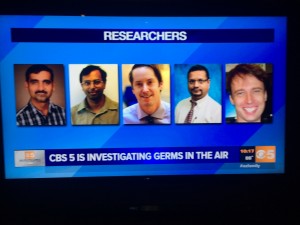
VIPRA Research Featured on CBS 5 News, Phoenix: The Phoenix affiliate of CBS interviewed Project VIPRA researchers and presented a news segment on our research

Project VIPRA Results Get Extensive News Coverage: Results from Project VIPRA were covered in around 40 international news outlets in four continents, including newspapers and magazines such as The Economist, Fox News, Economic Times, Navbharat Times, and India Today, with total monthly unique readership of around 1.8 billion. Please see the ‘Press Coverage’ tab for further details.
Talk at International Conference of Composites Engineering: A talk on Project VIPRA was presented at ICCE 2017. P. Derjany, S. Namilae, A. Mubayi, M. Scotch, and A. Srinivasan, Molecular Dynamics Like Numerical Approach for Studying Infection Propagation, International conference of composites Engineering ICCE (2017).
Talks at International Conference for Risk Analysis: Ashok Srinivasan and Sirish Namilae gave invited talks related to Project VIPRA at ICRA, Chicago, 2017.
- S. Namilae, Multiscale Model for Pedestrian and Infection Dynamics During Air Travel.
- A. Srinivasan, Optimizing Massively Parallel Simulations of Infection Spread Through Air-travel for Policy Analysis.
HPC Wire Article on VIPRA: HPC Wire published an article on Project VIPRA titled Using Blue Waters Supercomputer to Better Understand Ebola Transmission.
NCSA News Article on VIPRA: The National Center for Supercomputing Applications featured Project VIPRA in their news today. The news article is available on the University of Illinois' National Center for Supercomputing Applications website.
Physica-A Paper on Passenger Movement Modeling: A paper on the pedestrian dynamics modeling of Project VIPRA has been published in Physica A. Its details are as follows. S. Namilae, A. Srinivasan, A. Mubayi, M. Scotch, and R. Pahle, Self-Propelled Pedestrian Dynamics Model: Application to Passenger Movement and Infection Propagation in Airplanes, Physica A, vol. 465 (2017) 248-260.
Presentation at Blue Waters Symposium: Ashok Srinivasan represented Project VIPRA at the Blue Waters Symposium in Sun River, OR. He gave a talk on Simulation-Based Policy Analysis To Reduce Ebola Transmission Risk in Air Travel. He was later interviewed by the NCSA Public Affairs team so that this research could be shared with a wider audience.
Science Node article on VIPRA: The online international science magazine, Science Node, featured an article on Project VIPRA - Fear of flying: Combating disease spread with HPC.
International Conference on Molecular Epidemiology and Evolutionary Genetics of Infectious Diseases: An abstract on "Combining Human Movement Models with Phylogeography for Airplane Policy Options During Ebola Outbreaks" has been accepted for presentation at the 13th International Conference on Molecular Epidemiology and Evolutionary Genetics of Infectious Diseases (MEEGID 2016). It is co-authored by M. Scotch, R. Beard, R. Pahle, A. Mubayi, S. Namilae, and A. Srinivasan.
Poster at Pacific Symposium on Biocomputing: A poster on “The Spread of the 2014 Ebola Zaire Virus in West Africa” was presented at the Pacific Symposium on Biocomputing (PSB), 2016. It was co-authored by M. Scotch, R. Beard, R. Pahle, A. Mubayi, S. Namilae, and A. Srinivasan.
International Conference on Transport and Health: An abstract for oral presentation on “Self-Propelled Pedestrian Dynamics Model for Studying Infectious Disease Propagation during Air-Travel” has been accepted at the International Conference on Transport and Health (ICTH), 2016. It is co-authored by S. Namilae, A. Srinivasan, C.D. Sudheer, A. Mubayi, R. Pahle, and M. Scotch.
CCGrid Paper on Parallelizing SPED: A paper on “Optimizing Massively Parallel Simulations of Infection Spread Through Air-Travel for Policy Analysis” has been accepted at the 16th IEEE/ACM International Symposium on Cluster, Cloud, and Grid Computing (CCGrid). It is co-authored by Ashok Srinivasan, C.D. Sudheer of IBM Research, and Sirish Namilae. It relates to efficient parallelization of the SPED pedestrian dynamics model.
Presentation at SC ’15 in NCSA Exhibit: We gave a presentation on Project VIPRA in the NCSA Exhibit at SC ’15.
Rachel Beard gets NIH Fellowship: Rachel Beard has been awarded a three-year National Institutes of Health (NIH) Ruth L. Kirschstein Research Service Award Individual Predoctoral Fellowship from the National Library of Medicine. Her sponsor is Matthew Scotch.
IEEE HiPC paper on Barrier: A paper on “Efficient Barrier Implementation on the POWER8 Processor” has been accepted at the 22nd IEEE International Conference on High Performance Computing (HiPC) (2015). It is co-authored by Ashok Srinivasan and C.D. Sudheer of IBM Research. It relates to the issue of making computations efficient.
InternetCoast Cites VIPRA Research: Ebola at 30,000 feet: FSU Researchers work to combat future outbreaks. InternetCoast News cites research conducted under project VIPRA. InternetCoast is a non-profit organization promoting economic growth in Florida through innovation and technology.
Sen. Nelson Lauds VIPRA Project: Senator Nelson (FL) lauded research conducted under project VIPRA and congratulated it on received funding from the National Science Foundation - Senator Nelson letter.
NCSA Press Release on Ebola Projects: Blue Waters to help researchers tackle Ebola. Nation Center for Supercomputing Applications press release cites funding received by project VIPRA.
FSU Press Release on VIPRA: Ebola at 30,000 feet: Researchers work to combat future outbreaks. Florida State University press release on research conducted under project VIPRA.
VIPRA Obtains NSF Funding to Study Ebola: Project VIPRA received Rapid Response Research grant funding in April 2015 from the National Science Foundation for Simulation-Based Policy Analysis For Reducing Ebola Transmission Risk in Air Travel.