


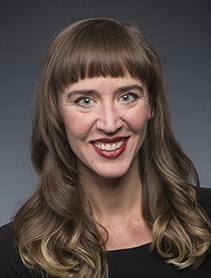
Allysha Winburn
- Position: Associate Professor
- Department: Anthropology
- Office Location: Building 13, Room 305
- awinburn@uwf.edu
- Campus: 850.474.2795
- apwinburn.com
Biography
Dr. Allysha Winburn is an associate professor of anthropology and a practicing forensic anthropologist.
A Diplomate of the American Board of Forensic Anthropology and a Registered Professional Archaeologist, she conducts research on skeletal aging and age estimation and the skeletal embodiment of structural inequity. She currently serves as the Highly Qualified Expert in Biological Anthropology for the U.S. Office of Army Cemeteries, in which capacity she leads the forensic anthropology laboratory for the Army's Carlisle Barracks Disinterment Program.Winburn has held a variety of leadership roles within the field of forensic anthropology, including as Chair of the American Academy of Forensic Sciences Anthropology Section in 2023, Secretary in 2022, and Program Chair in 2021. She is taking a leave of absence from teaching (2026-2027) in order to serve as the Forensic Laboratory Coordinator for the Office of the Director of Authorised Intervention, Tuam in Galway, Ireland.
Degrees & Institutions
Winburn received a bachelor’s degree in archaeological studies from Yale University, master’s degree in anthropology from New York University, and doctorate in anthropology from the University of Florida.
Research
Forensic Anthropology and Race
Publications
2022 Stephanie Hartley, Allysha P. Winburn, and Itiel E. Dror. Metric Forensic Anthropology Decisions: Reliability and Biasability of Sectioning-Point-Based Sex Estimates. Journal of Forensic Sciences 67:68-79. doi.org/10.1111/1556-4029.14931
2022 Allysha P. Winburn, Phoebe R. Stubblefield, and Susan C. Antón. Introduction to the Forensic Anthropology Special Issue on Diversity and Inclusion. Forensic Anthropology 5: 79-83. doi.org/10.5744/fa.2021.0023
2022 Allysha P. Winburn, Sean D. Tallman, Audrey L. Scott, and Cate E. Bird. Changing the Mentorship Paradigm: Survey Data and Interpretations from Forensic Anthropology Practitioners. Forensic Anthropology 5:115-132. doi.org/10.5744/fa.2020.4028
2022 Allysha P. Winburn, Antaya L. Jennings, Dawnie W. Steadman, and Elizabeth A. DiGangi.
Ancestral Diversity in Skeletal Collections: Perspectives on African-American Body Donation. Forensic Anthropology 5:141-152. doi.org/10.5744/fa.2020.1023
2022 Donovan Adams*, Justin Goldstein*, Mari Isa*, Jaymelee Kim*, Megan Moore*, Marin
Pilloud*, Sean D. Tallman*, and Allysha P. Winburn*. A Conversation on Redefining Ethical Considerations in Forensic Anthropology. American Anthropologist. *Equal doi.org/10.1111/aman.13753
2021 Allysha P. Winburn and Chaunesey M.J. Clemmons. Response to Letter to the Editor
regarding Objectivity is a Myth that Harms the Practice and Diversity of Forensic Science. Forensic Science International (FSI): Synergy. doi.org/10.1016/j.fsisyn.2021.100212
2021 Allysha P. Winburn and Chaunesey M.J. Clemmons. Objectivity is a Myth that Harms the Practice and Diversity of Forensic Science. FSI: Synergy. doi.org/10.1016/j.fsisyn.2021.100196
2021 Allysha P. Winburn, Chaunesey M.J. Clemmons*, Thomas A. Delgado*, Stephanie
Hartley*, Krista E. Latham*, Marin A. Pilloud*, Sean D. Tallman*. Responding to the American Academy of Forensic Sciences Vision, Mission, and Values Statements: Comments, Revisions, and Proposed Actions. FSI: Synergy. *Equal coauthors. doi.org/10.1016/j.fsisyn.2021.100197
2021 Sean D. Tallman, Nicolette M. Parr, and Allysha P. Winburn. Assumed Differences; Unquestioned Typologies: The Oversimplification of Race and Ancestry in Forensic Anthropology. Forensic Anthropology 4:73-96. doi.org/10.5744/fa.2020.0046
2021 Stephanie Hartley and Allysha P. Winburn. A Hierarchy of Expert Performance as Applied to Forensic Anthropology. Journal of Forensic Sciences 66:1617-1626. doi.org/10.1111/1556-4029.14761
2021 Aubrie Sanchez, Sean D. Tallman, Allysha P. Winburn, and Joshua Stefanik. The Effects of Orthopedic Pathologies on the Prevalence of Hip Osteoarthritis. Homo 72:183-203. DOI: 10.1127/homo/2021/1329
2021 Allysha P. Winburn and Bridget F.B. Algee-Hewitt. Evaluating Population Affinity Estimates in Forensic Anthropology: Insights from the Forensic Anthropology Database for Assessing Methods Accuracy (FADAMA). Journal of Forensic Sciences 66:1210-12:19. doi.org/10.1111/1556-4029.14731
2019 Allysha P. Winburn, Michala K. Stock. Reconsidering Osteoarthritis as a Skeletal Indicator of Age at Death. American Journal of Physical Anthropology 170:459-473. doi.org/10.1002/ajpa.23914
2019 Carme Rissech, Allysha P. Winburn, Marta San-Millán, Jaume Sastre, Jairo Rocha. The Acetabulum as an Adult Age Marker and the New IDADE2 (the IDADE2 Web Page). American Journal of Physical Anthropology 169:757-764. doi.org/10.1002/ajpa.23856
2019 Allysha P. Winburn. Validation of the Acetabulum as a Skeletal Indicator of Age at Death in Modern European-Americans. Journal of Forensic Sciences 64:989-1003. doi.org/10.1111/1556-4029.13972
2018 Allysha P. Winburn Subjective with a Capital S? Issues of Objectivity in Forensic Anthropology. In Forensic Anthropology: Theoretical Framework and Scientific Basis, 1st Edition (Cliff and Donna Boyd, editors). Chapter 2, pp. 21-37. John Wiley & Sons Ltd., Hoboken, NJ.
2017 Michala K. Stock, Allysha P. Winburn, George H. Burgess. Skeletal Indicators of Shark Feeding on Human Remains: Evidence from Florida Forensic Anthropology Cases. Journal of Forensic Sciences 62:1647-1654. doi.org/10.1111/1556-4029.13470
2017 Allysha P. Winburn, Katie M. Rubin, Carrie B. LeGarde, Janet E. Finlayson. Use of Qualitative and Quantitative Techniques in the Resolution of a Small-Scale Medicolegal Case of Commingled Human Remains. Florida Scientist 80:24-37. jstor.org/stable/44202492
2017 Allysha P. Winburn, Raphael Martinez, Sarah Schoff. Afro-Cuban Ritual Use of Human Remains: Medicolegal Considerations. Journal of Forensic Identification 67:1-30.
2016 Allysha P. Winburn, Sarah K. Schoff, Michael W. Warren. Assemblages of the Dead: Interpreting the Biocultural and Taphonomic Signature of Afro-Cuban Palo Practice in Florida. Journal of African Diaspora Archaeology and Heritage 5:1-37. doi.org/10.1080/21619441.2016.1138760
Keywords: forensic anthropology, bioarchaeology, human osteology, human evolution, skeletal biology, medicolegal, medical examiner, age at death, age estimation, aging, arthritis