


Build Study Routine 2 of 3: Space & Setup
September 15, 2026 | Jennifer Griffin | jgriffin@uwf.edu
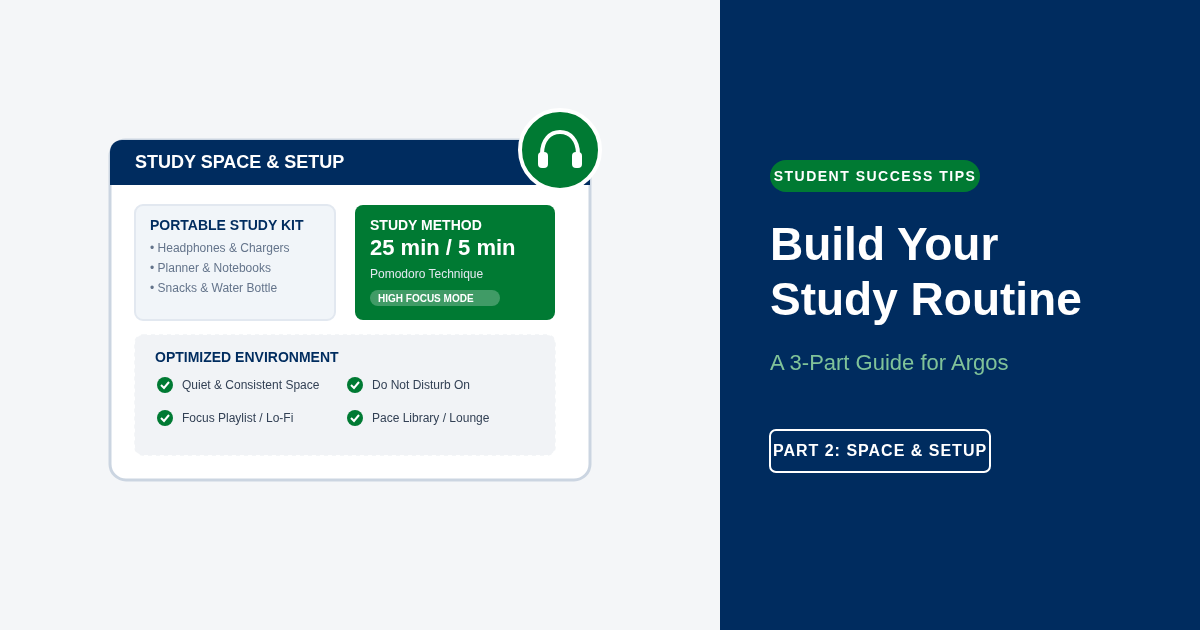
Create an effective study space.🧑💻
If you prefer to study at home, create a study space that will allow you to focus and be effective. Ideally, this will be a consistent and quiet space. When creating this space, consider:
- Removing distractions.
- Having study materials readily available.
- Turning on Do Not Disturb.
- Trying different types of music to see if background noise helps you.
- Having access to water and healthy snacks available.
If you prefer a coffee shop or library (or do not have access to a consistent space), consider creating a portable study kit. Have a bag ready to take with you wherever you study.
You could include:
- A variety of writing utensils (pen, pencils, highlighters, etc)
- A planner (if you use one)
- Notebook(s)
- Chargers
- Textbooks
- Water bottle
- Healthy snacks
- Headphones
Figure out a study method that works for you. 📚
Let’s be honest, it can be hard to sit down and study for hours, but a study method can help with that. There are different options that may be helpful. I have included a few options to consider below:
- The Pomodoro Method: Sit and focus for 25 minutes, then take a 5-minute break, then repeat. This method can be useful for students who have a hard time getting started.
- 50/10 Method - This method is similar to the Pomodoro Method but longer. Work for 50 minutes, then take a 10-minute break and repeat.
- Task-Based Studying - Work until you get a specific task done, then take a break. Then move on to the next task.
- TIP: Break down your bigger tasks. For example, writing a paper is too big a task. Instead, break it down into steps - 1. Write an outline, 2. Research to find relevant sources, 3. Write the introduction, 4. Write the body, 5. Write the conclusion, 6. Edit, revise, and format. Completing each step becomes more realistic and manageable rather than sitting down to write a full paper.
- The Feynman Technique - Trying to learn a difficult concept? Then this may be for you! Find a friend or family member who is unfamiliar with the concept, and explain it in simple language. They can help you identify the gaps in your knowledge.
There are many different methods for studying, depending on your preferences and what you are studying. Try out a few to determine which works best for you and your needs!
Next Up: You have your time blocked and your study space ready, but what happens when motivation wanes, life disrupts your schedule, or procrastination hits? Head over to Build Study Routine 3: Roadblocks for practical strategies to overcome common study hurdles and keep your momentum going!


