


25
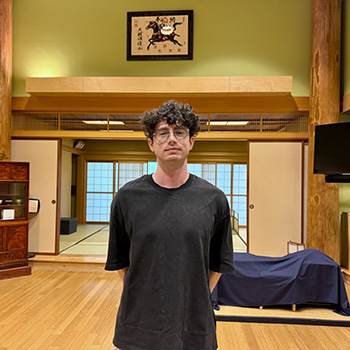
Tyler Howell
English Language Arts instructor in Kogyokusha Junior and Senior High School, Tokyo, Japan
As an instructor in Japan, Tyler Howell helps students prepare for admission to American and European universities through instruction in English with a dynamic and engaging classroom environment.
When did you first become interested in Japanese culture and pursuing a career in Japan?
While I was growing up, my dad loved to show me Tokusatu movies, a style of Japanese live-action filming that relies heavily on practical effects – think the original Godzilla movie. That being said, I didn’t start studying Japanese until I was about 23. Early challenges included identifying basic parts of speech to form sentences and freely producing the basic characteristics of Hiragana and Katakana, two writing systems used in Japan. Through these challenges, Takami Taylor, a senior instructor of Japanese in the Reubin O'D. Askew Department of Government, supported and guided me. I genuinely would not be where I am today without her help. She also encouraged me to explore the Japanese Exchange and Teaching program, better known as JET.
What is the JET program?
JET is a teaching exchange program hosted by the Japanese government, in partnership with countries around the world, that provides Japanese primary and secondary school students with the opportunity to engage with English-speaking foreign teachers to advance their language education. It also provides JET teachers with the opportunity to experience Japan through the lens of a professional educator across a wide range of placement locations, from big cities like Tokyo to small countryside towns in the mountains of Yamagata. As an instructor, I launched various Content and Language Integrated Learning, or CLIL, which focuses on teaching both a subject and language simultaneously. I’ve also been developing International Exchange Programs for my students. Besides teaching language, I try to foster a more dynamic classroom environment as we would typically see in an American classroom. After completing the JET Program, I continued teaching full-time in Tokyo for several years. I’m incredibly excited that starting in the Spring of 2027, I will become a permanent faculty member at Kogyokusha. Going forward, I will be considered a professional educator and long-term member of the school's faculty.
How advanced in a language should students be before applying for an international career?
Language learning is a lifelong process, and I’m still developing my skills to this day. However, if there are any current UWF students considering international careers, try achieving conversational proficiency in the language of the country you are interested in. It’s also important to have some certification to prove your language proficiency in your application. Most employers in Japan and elsewhere are looking for people who can seamlessly integrate into the native language and internal culture of their companies. UWF offers an excellent foundation for a wide variety of languages that can allow students to broaden their horizons around the world.