


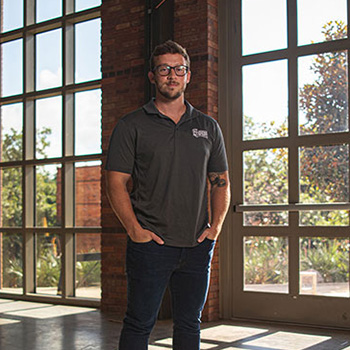
Steven Thornton
Mechanical Engineer at the Institute for Human and Machine Cognition
Thornton performs many different roles at IHMC, including working on his ongoing project, Nadia, a high-speed and high-range-of-motion humanoid robot.
When did you first become interested in mechanical engineering?
Once I graduated high school, I did what a lot of high school graduates do and started college. But five weeks into my first semester at UWF, I realized I was failing to keep up, and I dropped out. From there, I bounced around a lot working in restaurants, lawn care, construction and even considered the military and working on oil rigs. Luckily, inspiration struck from an unlikely source. I found myself watching The Martian, and it made me wonder, ‘What does it take to work for NASA?’ One quick Google search later, I learned that a degree in mechanical engineering was one way to get in the door.
How did you turn your educational dreams into a realistic goal?
Throughout my education, I always had to keep putting one foot in front of the other. Mechanical engineering felt like the right path because I always had a natural inclination for math and science. I also liked working with my hands. As a kid, my grandfather taught me how to work on old cars, which led to an interest in mechanics. After five years away from the classroom, I enrolled at Pensacola State College in the pre-engineering program. I went on to complete my associate degree and enroll again at UWF — this time, a very different person than the uncertain high school graduate I once was. There I met Research Associate Dr. Joseph Piacenza from the Department of Mechanical Engineering. He encouraged me to apply to be a part of the UWF Society of Automotive Engineers Baja team, an extracurricular intercollegiate competition for designing and fabricating off-road vehicles. Ultimately, I became the captain of the SAE Baja team for two years, which helped me create a competitive resume.
How did you connect with your current employer IHMC?
As I was nearing graduation, a guest speaker from the Institute of Human and Machine Cognition visited my class. The speaker showed the class a video of what was possible at the not-for-profit IHMC — a near fantasyland of technology and research aimed at leveraging and extending human capabilities. Partners for the Institute included Microsoft, several branches of the U.S. military, Boeing and, to my excitement, NASA. Enthralled, I followed him out of class and asked if he would pass along my resume to someone at the organization. The stars aligned, and a few weeks before graduation, I was offered a position at the prestigious institute. Now my team and I are working on Nadia, a high-speed and high-range-of-motion humanoid robot. It has been a great ride, and I’m proud of where I am, but there’s still so much more I want to accomplish. Thanks to my experiences, I know that even if it takes a lot longer than you would expect or want it to, if you show up every day and work on your goal, it will eventually happen.