Research Revolution Challenge 2026
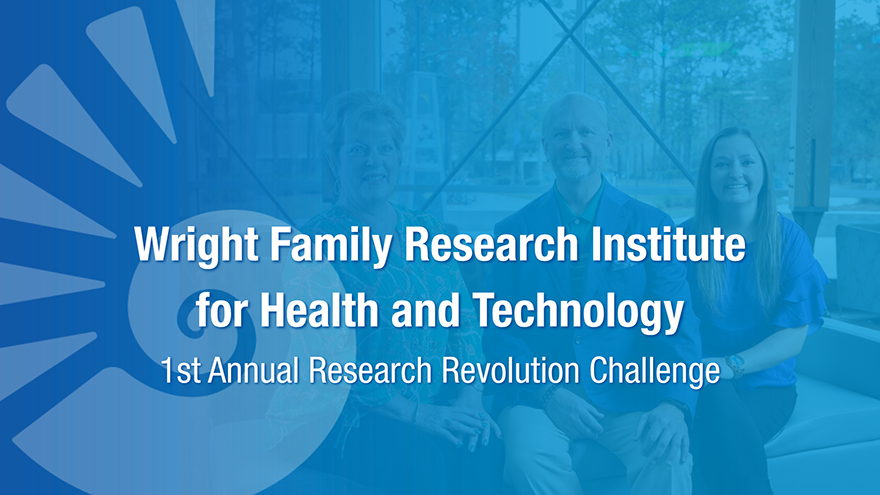
The Research Revolution Challenge, sponsored by the Wright Family Research Institute (WRFI) for Health and Technology and Coastal Connection, is a university-wide research competition that invites interdisciplinary faculty-student teams to develop AI-driven solutions addressing real-world health challenges with implementable solutions relevant to Northwest Florida and beyond. The competition is structured as a multi-phase challenge culminating in an invitation-only live Demo Day.
About the Challenge
- No coding experience required — all approaches welcome
- Win up to $25,000 and launch your research product
- Build your resume with real AI + health experience
- Interdisciplinary teams — meet faculty and students from across UWF
More than $40,000 in prizes
- 1st Place: $25,000
- Sponsored by Coastal Connection
- 2nd Place: $10,000
- Sponsored by Florida Blue
- 3rd Place: $4,000
- Sponsored by the UWF Foundation
- Best Interdisciplinary Team: $2,500
- Sponsored by The Office of the Provost
- Best Community Partnership Team: $2,500
- Sponsored by Mr. Bruce Vredenburg
- Summer Undergraduate Research Program (SURP) Fellowship: $4,000 per student
- Sponsored by Hal Marcus College of Science and Engineering
- Best 4 undergraduate student awards
- 2 - $500 project awards; 2 - $1,000 travel awards
- Sponsored by the Office of Undergraduate Research
- Best 2 graduate student awards
- 2 - $750 travel awards
- Sponsored by Graduate Studies
Awards will be announced at the Faculty Awards Ceremony on November 19, 2026.
Non-Monetary Awards
- All finalists receive certificates of recognition
- Top 3 teams featured in UWF news and social media
- Invitation to present at UWF Student Scholars Symposium
- Opportunity to continue development through SURP, OUR Project Awards, or Center for Computational Intelligence partnerships
- Single broad topic ("Using AI to Address a Health Challenge")
- Interdisciplinary by design — teams must include at minimum one faculty and one student, members from at least two colleges/departments are strongly encouraged.
- Accessible to all skill levels (no-code, low-code, and code-based solutions welcome)
- Grounded in real community health needs
- Produces tangible, potentially deployable prototypes or proof-of-concepts
- No-code: GPT wrappers, Copilot Studio, Bubble, Streamlit
- Low-code: AutoML platforms, Google Colab notebooks, Hugging Face
- Full-code: Python/R ML pipelines, deep learning, NLP, computer vision
- All approaches are equally valid; judging focuses on problem-solution fit
Team Member Requirements and Skill Recommendations
- Open to all currently employed UWF faculty and currently enrolled UWF students (undergraduate and graduate)
- Community partners may serve as advisors but not team members
- No prior AI experience required
- Team size: minimum of 2 members, including at least one faculty member and one student on each team
- Each faculty and student may only be on one team
Interdisciplinary teams are recommended.
- At least one member with health/clinical domain knowledge
- At least one member with technical/computational skills
- At least one member with communication/design skills
- A team may include both undergraduate and graduate students
Competition Phases and Project Requirements
(April 24, 2026-May 22, 2026)
- Teams register and submit a 1-page, 500 word maximum PDF Concept Brief covering:
- Problem statement with evidence of health need
- Proposed AI approach (what AI technique, why it fits)
- Preliminary data sources identified
- Team roster with majors/colleges and relevant skills
- List any community advisors including their name, title, affiliation, and email address
DUE May 22, 2026
**No prototype is required during Phase 1.
(May 23, 2026-August 17, 2026)
- Teams develop their prototype/proof-of-concept
- Final submission deadline to include:
- Technical Report (5–8 page PDF)
- Problem background and significance
- AI methodology and tools used
- Data sources (real, simulated, or publicly available)
- Results and evaluation metrics
- Ethical considerations and limitations
- Future development roadmap
2. Working Prototype or Demo
- Functional demo (app, website, notebook, chatbot, dashboard, etc.)
- OR video walk through (max 3 minutes) if live demo is impractical
- Source code repository (GitHub) if applicable
3. Recorded Video Presentation and Presentation file.
- All members of the team must participate in the presentation.
- The presentation should be no longer than 8 minutes total, including the functional demo or video walkthrough.
- The submitted presentation should be used if invited for the Demo Day presentation, with slight modifications accepted.
DUE August 17, 2026
Review of submitted projects will occur from August 18, 2026-October 4, 2026.
Invitations to present on Demo Day will be sent to advancing teams on October 5, 2026.
November 2, 2026
- Held in-person on UWF Pensacola Campus
- Format: 8-minute presentation + 5-minute Q&A per team
- Live judging panel scores each team
Awards announced Faculty Awards Ceremony Nov 19, 2026.
Project Rubric
Projects will be scored against the following rubric by the WFRI Board.
Scoring Rubric (Total: 100 points):
- Problem Significance (20 pts):
- Is the health challenge clearly defined with evidence?
- Is it relevant to real populations?
- Innovation & AI Application (25 pts):
- Is the AI approach appropriate, creative, and technically sound?
- Feasibility & Prototype (20 pts):
- Is there a working demo, prototype, or compelling proof-of-concept?
- Is the solution realistic to implement?
- Impact & Scalability (15 pts):
- Could this solution meaningfully improve health outcomes?
- Can it scale beyond the prototype?
- Ethical Considerations (10 pts):
- Does the team address bias, privacy, equity, and responsible AI use?
- Presentation Quality (10 pts):
- Is the presentation clear, compelling, and well-structured?
- Presentation for Demo Day (10 pts):
- Does the team handle Q&A effectively?
- Replace presentation quality for Live Demo Day presentations
Scoring Scale per Criterion
5 — Exceptional: Exceeds expectations; among the best possible
4 — Strong: Clearly above average; well-executed
3 — Competent: Meets expectations; solid but not distinctive
2 — Developing: Below expectations; significant gaps
1 — Insufficient: Fails to meet minimum standards
Each criterion score (1–5) is multiplied by its weight to produce the final score.
Awards announced Faculty Awards Ceremony Nov 19, 2026.
For questions about the competition, please contact Dr. Karen S. Molek at ksmolek@uwf.edu
Sponsored by: