


CCAI Academic Certificates and Courses
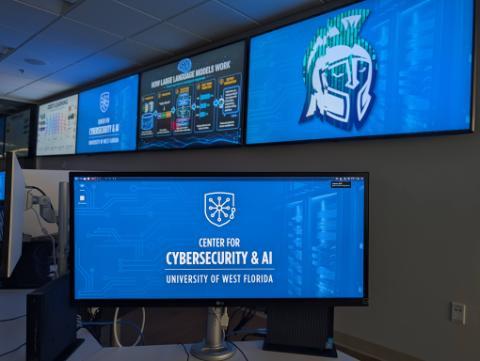
The University of West Florida Center for Cybersecurity and AI offers online undergraduate and graduate certificates as well as for-credit courses to prepare both degree- and non-degree-seeking UWF students and working professionals for AI and cybersecurity job needs.
Academic Certificates
The University of West Florida (UWF) Center for Cybersecurity and AI (CCAI) offers three online Artificial Intelligence and Cybersecurity certificates built for both degree-seeking students and non-degree working professionals. Whether you're just starting or ready to advance your career, these programs deliver practical, job-ready skills — no AI or coding background required for the AI certificates!
Artificial Intelligence in Practice Undergraduate Certificate (Online)
This 3-course (9 credit hours) online certificate program helps students with any major/background develop practical AI skills that enhance career readiness and complement their academic studies. Through hands-on learning, students explore AI, machine learning, Generative AI, and data-driven problem-solving. The certificate can be completed in just 2 to 3 semesters and will prepare you for high-demand roles such as AI Engineer, Software Developer, Threat/Warning Analyst, and Data Analyst.
Ready to take the next step? Review all certificate program details and then submit your application here: https://apply.uwf.edu/apply/. Make sure to select your desired entry term and choose the Artificial Intelligence in Practice Undergraduate Certificate Program.
Artificial Intelligence in Practice Graduate Certificate (Online)
This 3-course (9 credit hours) online certificate program is designed for graduate students and working professionals across industries. The certificate, which can be completed in just 2 to 3 semesters, provides practical, workforce-focused AI knowledge through hands-on projects and real-world applications. Students learn how to leverage AI to improve productivity, decision-making, and innovation in their organizations and are prepared for high-demand roles such as AI Engineer, Software Developer, Threat/Warning Analyst, and Data Analyst.
Ready to take the next step? Review all certificate program details and then submit your application here: https://graduatedegrees.uwf.edu/apply/. Make sure to select your desired entry term and choose the Artificial Intelligence in Practice Graduate Certificate Program.
Artificial Intelligence and Cybersecurity Graduate Certificate (Online)
This 3-course (9 credit hours) certificate program prepares students and working professionals to navigate the intersection of two of the fastest-growing and highest-demand fields in technology! Cyber threats are becoming more sophisticated, and organizations need professionals who can leverage AI to detect malicious activity faster, automate defenses, analyze massive volumes of security data and strengthen cyber resilience. The online certificate can be completed in just 2 to 3 semesters and combines advanced cybersecurity knowledge with practical AI and deep learning applications that equips individuals with the critical skills needed to develop, implement and evaluate AI-driven solutions in cybersecurity contexts.
Ready to take the next step? Review all certificate program details and then submit your application here: https://graduatedegrees.uwf.edu/apply/. Make sure to select your desired entry term and choose the Artificial Intelligence and Cybersecurity Graduate Certificate Program.
Academic Courses
Visit the Computing: Artificial Intelligence (CAI) Course Descriptions webpage to learn more.
CAI 4002 Artificial Intelligence Fundamentals
Syllabus: CAI 4002 Syllabus
3 credit hours (may not be repeated for credit)
Prerequisites: COP 2253 OR COP 2334 OR EEL 4834
Description: Artificial Intelligence Fundamentals is an introductory course designed for students seeking to explore the foundational concepts and techniques of Artificial Intelligence (AI). Throughout this course, students will gain a comprehensive understanding of the principles that underpin AI, including machine learning, natural language processing, computer vision, and robotics.
CAI 4802 Artificial Intelligence and Machine Learning for Cybersecurity
3 credit hours (may not be repeated for credit)
Prerequisites: COP 2253 OR COP 2334 OR EEL 4834
Description: As Artificial Intelligence is being used in our daily activities, it is imperative to be aware of its capabilities and applications to address existing and emerging cybersecurity threats. This course will provide an introduction to Artificial Intelligence, cybersecurity threats, machine learning, and how AI applications are developed using real-world datasets to address cybersecurity-related problems. Topics will include, but are not limited to, supervised and unsupervised machine learning techniques, and the application of AI in solving cybersecurity-related problems such as anomaly, spam email, and malware detection. The course will use hands-on practices using an environment such as Google Colab, where learners will practice how machine learning applications are developed and tested. Learners will be able to evaluate the performance of AI applications using various metrics. The course will cover data preprocessing, AI risks and misuses, mitigation, and best practices.
CAI 4827 Artificial Intelligence Enabled Software Development
3 credit hours (may not be repeated for credit)
Prerequisites: CAI 4930 OR CAI 4002
Description: This course offers students an immersive journey into the world of artificial intelligence and its applications in software development. This course is designed to equip students with the fundamental concepts and practical skills necessary to develop intelligent software solutions that respond to real-world challenges. Students will explore the principles of AI, while gaining hands-on experience with popular AI programming tools.
CAI 4930 Emerging Trends in Artificial Intelligence
3 credit hours (may not be repeated for credit)
Prerequisites: None
Description: This course covers an introduction to and applications of Artificial Intelligence (AI). Topics include but are not limited to the history and evolution of AI, the technical AI applications in domains such as healthcare, supply chain, business, transportation, law enforcement, arts and creative works, and social well-being. The course discusses new AI trends and opportunities, including Generative AI, Large Language Models, such as ChatGPT, and prompt engineering for improved productivity. It also covers AI technology best practices, ethics, and risks. The course is intended for anyone interested in AI and its applications and benefits to improve daily activities, processes, and productivity. Offered concurrently with CAI 5931. Graduate students will be assigned additional work. Open to students from any major; no prior background in AI required.
CAI 5931 Emerging Trends in Artificial Intelligence
3 credit hours (may not be repeated for credit)
Prerequisites: None
Description: This course covers an introduction to and applications of Artificial Intelligence (AI). Topics include but are not limited to the history and evolution of AI, the technical AI applications in domains such as healthcare, supply chain, business, transportation, law enforcement, arts and creative works, and social well-being. The course discusses new AI trends and opportunities, including Generative AI, Large Language Models, such as ChatGPT, and prompt engineering for improved productivity. It also covers AI technology best practices, ethics, and risks. The course is intended for anyone interested in AI and its applications and benefits to improve daily activities, processes, and productivity. Offered concurrently with CAI 4930. Graduate students will be assigned additional work. Background requirements: Open to students from any major; no prior background in AI required.
CAI 6005 Artificial Intelligence Fundamentals
Syllabus: CAI 6005 Syllabus
Course Dates: Fall 2026 (First Half Term (2): 08/17/2026 - 10/10/2026)
Credit Hours: 3 credit hours
Delivery Format: Asynchronous online
Target Audience: Degree-seeking and non-degree seeking-graduate students from all majors
Prerequisites: None. No programming, technical, or AI experience is required. Students will learn using intuitive no-code and low-code AI tools.
Course Description: Artificial Intelligence Fundamentals is an applied, hands-on introduction to Artificial Intelligence (AI) designed for students from all academic disciplines who want to understand and use AI in their future careers. Students will learn how modern AI technologies, including machine learning, deep learning, large language models, natural language processing, computer vision, and generative AI, are transforming industries such as business, healthcare, cybersecurity, education, finance, engineering, manufacturing, and government. Using no-code and low-code AI platforms, pre-trained AI models, and generative AI tools, students will gain practical experience applying AI to solve real-world problems, evaluate AI-generated results, and support data-informed decision-making. Throughout the course, students will also examine AI ethics, governance, security, and responsible AI practices while developing the knowledge and confidence to leverage AI effectively in academic, professional, and personal settings.
CAI 6803 Deep Learning for Cybersecurity
Syllabus: CAI 6803 Syllabus
3 credit hours (may not be repeated for credit)
Prerequisites: None
Description: Deep Learning (DL) is a branch of Artificial Intelligence (AI) that utilizes multi-layered artificial neural networks to deliver state-of-the-art accuracy in tasks such as object detection, speech recognition, deep network packet inspection, image recognition, and language translation. With the use of DL, computers can learn and recognize patterns from data that is considered too complex or subtle for computer applications. DL has been successfully deployed in numerous domains such as healthcare for medical diagnosis, retail merchandising for enhancing customer shopping experiences, transportation for autonomous driving, and finance for stock market behavior analysis. This course will cover the fundamentals of DL, the mechanics of DL, pre-trained models, recurrent networks, object classification, and transfer learning. The course will culminate with applied hands-on exercises on applying DL on real-world cybersecurity problems.
CAI 6804 Artificial Intelligence and Machine Learning for Cybersecurity
3 credit hours (may not be repeated for credit)
Prerequisites: None
Description: This course will provide an introduction of Artificial Intelligence (AI) and its application to solve cybersecurity-related problems. Topics will include, but are not limited to, supervised and unsupervised ML techniques and solving cybersecurity-related problems. The course will use hands-on practices to develop and evaluate the performance of ML applications. The course will cover AI technology-related risks and the best practices to minimize the risks.
CAI 6828 Artificial Intelligence Enabled Software Development
3 credit hours (may not be repeated for credit)
Prerequisites: CAI 6005 OR CAI 5931
Description: This course introduces the integration of artificial intelligence (AI) techniques and tools in the software development lifecycle. Students will learn how AI can enhance requirements analysis, design, coding, testing, debugging, deployment, and maintenance of software systems. The course covers the use of common AI models to support productivity, automation, and innovation in software engineering. Ethical, legal, and professional issues related to AI-assisted development will be emphasized.
CAI 6950 Artificial Intelligence Capstone
3 credit hours (may not be repeated for credit)
Prerequisites: CTS 5129 OR CAI 6803 OR CAI 6828
Description: The Artificial Intelligence (AI) capstone project is a culminating experience where students apply the knowledge and skills gained throughout their prior knowledge and skills to solve a real-world problem focused on cybersecurity/privacy using AI techniques. The project can be done individually or as a team. Students will design, develop, evaluate, and present a significant AI-based system. The course also covers project planning, development, ethical considerations, and professional presentation of the findings.
Visit the Computer Technology and Skills (CTS) Course Descriptions webpage to learn more.
CTS 5129 Certified Information Systems Security Professional (CISSP)
3 credit hours (may not be repeated for credit)
Prerequisites: None
Description: This course provides a comprehensive overview of the principles and practices of information security management, structured around the eight domains of the ISC2 Certified Information Systems Security Professional (CISSP) Common Body of Knowledge (CBK). Designed to support preparation for the CISSP certification, an internationally recognized, ANSI-accredited credential, this course emphasizes security from a strategic and managerial perspective. Topics include Security and Risk Management, Asset Security, Security Architecture and Engineering, Communication and Network Security, Identity and Access Management, Security Assessment and Testing, Security Operations, and Software Development Security.
Admission & Registration Steps
To take CCAI courses or to pursue the certificates, you must first be admitted to UWF as either a degree-seeking or non-degree-seeking student.
- For the Artificial Intelligence in Practice Undergraduate Certificate, submit your application here: https://apply.uwf.edu/apply/.
- For the Artificial Intelligence in Practice Graduate Certificate, submit your application here: https://graduatedegrees.uwf.edu/apply/.
- For the Artificial Intelligence and Cybersecurity Graduate Certificate, submit your application here: https://graduatedegrees.uwf.edu/apply/.
Great news: You don't have to wait for certificate program acceptance to register for courses, as long as you are admitted to the university! Your completed courses will count toward the certificate.
- Degree-Seeking Students: You can apply for the certificate program and, upon acceptance, work with your major academic advisor to add it to your current degree plan.
- Non-Degree Seeking Students: You can declare the certificate at any time during the application process or once you decide you want to complete all three courses.
Visit the UWF Online Tuition web page to review tuition costs and potential waivers.
Questions? Please contact:
Ms. Pam Davis, Program Manager, CCAI (pdavis2@uwf.edu).
Dr. Hossain Shahriar, Director of Educational Programs, CCAI (hshahriar@uwf.edu)


