


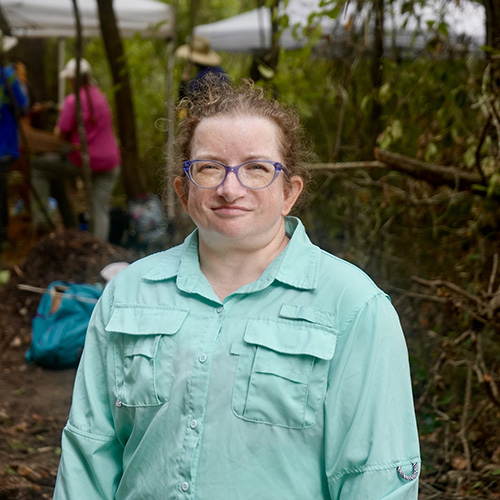
Jennifer Melcher
Senior Faculty Research Associate in the Archaeology Institute
Persistence Happens Here
It’s easy to start the history of our University with its founding in the 1960s, but in fact people have been enjoying our beautiful campus for much longer and shaping the landscape we see today. The site we’ve recently been studying tells a story of human persistence on UWF’s Pensacola campus potentially over the last 3,000 years. We can understand a lot about how humans in the area developed and interacted with the landscape from projects like this. Think of our understanding of North America – and most of the world – as a jigsaw puzzle with millions of pieces. Each little piece we find allows us to pull a picture of the past together. We can flesh out the pieces of the puzzle with oral and written histories, but the more pieces we lose, the more incomplete our picture. It’s incredibly important to be persistent in discovering and preserving all the pieces we can find.
In our research, we are finding a broad range of ceramic and stone fragments that were all part of daily life along Thompson’s Bayou for more than 2,000 years. To the untrained eye, these artifacts don’t necessarily look like much, generally a fairly plain brown. But from the persistent work of other archaeologists over the past 100 or so years, we can narrow down the date of pottery fragments to specific historical time periods. How and where we find these artifacts can tell us a lot about the people who made and used them. In many cases, we may be the first people to touch these artifacts since they were dropped or chipped off the edge of a stone tool. Over the next couple of months, we will take an in-depth look at the artifacts we recovered, finding out more about what people were eating, where they were making their pottery and where they went to gather the stones needed to make their tools. Each little piece of evidence helps us understand the bigger picture of what life was like on the Northern Gulf Coast before European contact.
Working on this research takes a lot of planning, thought and manual labor, and with the heat of a Pensacola summer, it isn’t the easiest thing to do. We have been incredibly lucky to have persistent students with great attitudes. Being in the field at 7 a.m. every day and working for eight hours straight can be difficult, but the thrill of each little discovery helps keep people going! For many of our students, this may be only their second or third field experience, so they are getting the additional training that will make them stand above many others when the time comes for them to apply for jobs or graduate school. This project is generally in line with what many of our students can expect when they enter the job market, so working in the field allows them hands-on experience while enhancing their skill sets. At UWF, our faculty, staff, students and even our history is rooted in the persistence of people. I’m grateful to have the opportunity to preserve that persistent spirit through this research project.