


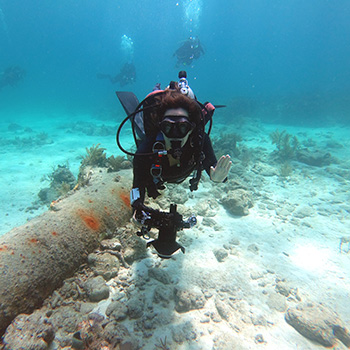
Nicole Grinnan
Assistant Director, UWF Archaeology Institute
As the assistant director for the Archaeology Institute at the University of West Florida, Nicole Grinnan connects people with the histories that shape their communities through maritime exploration and inspires them to become stewards of those stories for future generations.
How did you first become interested in maritime archaeology?
Ever since I was young, I’ve always been fascinated by human history. Understanding our stories, the lives people lived and the ways communities navigated across landscapes has always struck me as deeply important for how humanity understands its existence today. History, and especially anthropological archaeology, offered a way to explore those larger questions about our existence while studying outside, which was a game changer for me! My draw to maritime archaeology came a little bit later but, as I look back, I’ve always been interested in human relationships to the water. I’ve grown up in coastal communities and have a history of seafaring in my family. Maritime archaeology finally gave me the opportunity to combine my interests with exploration, scientific research and storytelling. To this day, I can’t think of a discipline that would appeal to me more.
What led you to pursue your master's degree at UWF?
By the time I was getting ready to start applying to graduate schools, I knew that I wanted to pursue a career in history and archaeology. I looked at several universities that had programs in historical archaeology and received good offers. However, when I rounded the corner in my undergraduate hallway one day and saw a poster with scuba divers working on a shipwreck that said “Study Maritime Archaeology at UWF!” I was sold. While a graduate student at UWF, I tried to take advantage of every research and engagement opportunity possible, with many opportunities to plug into research right in Pensacola’s backyard. I am now very fortunate to be full time faculty at UWF, serving as the Archaeology Institute’s assistant director since 2024. In some ways, it feels like I’ve come full circle: I was so grateful to be welcomed at UWF in 2010 and now I have the opportunity to do the same for other prospective students.
How are the archaeology resources at UWF unique to the University?
Studying history and archaeology at UWF is special for so many different reasons. We have one of very few dedicated programs in graduate maritime archaeology in the United States. The fact that we can provide students with the opportunity to study the oldest discovered European shipwrecks in Florida in Pensacola Bay is truly outstanding. Nowhere else in the United States do researchers have the ability to access corresponding 16th-century colonial sites on land and underwater. That also doesn’t include the thousands of years of precontact Indigenous history prior to Spanish settlement or the growth of Pensacola into a fledgling American port city after 1821. The depth of time represented in the Northwest Florida area is astounding; UWF is uniquely positioned to tap its research potential.