


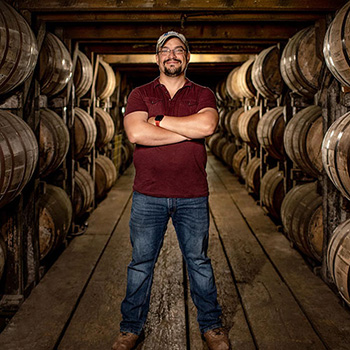
Nicolas Laracuente
Bourbon Archaeologist at the Kentucky Heritage Council
As a public archaeologist working with the Kentucky Heritage Council, Laracuente uses the education he received from the University of West Florida to research bourbon history in the Commonwealth of Kentucky.
Why did you choose Kentucky to begin your archaeology career?
After I finished up my master’s degree in anthropology at the University of West Florida, I headed to Kentucky to start my career. I live in Frankfort, a beautiful city with lots of rolling hills and natural scenery around the state. But what has really held my interest for over a decade has been what lies underneath the rivers and farmland: the history of American bourbon.
Why is it important to study the history of Bourbon?
Bourbon is America’s oldest spirit, and there's a rich layer of history found here in Kentucky that has been mostly overlooked. This field is important to study because distilleries intersect so many aspects of human society. When I first came to Kentucky as a professional archaeologist, I found that they do archaeology more or less in private. Now at the Kentucky Heritage Council, I’ve been able to integrate the concept of public archaeology, which I first learned at the University of West Florida. My ultimate goal is to bring this untold information into the public eye for all to enjoy. The history of bourbon remains just as rich, complex and high-quality as the drink itself.
What is the most interesting site you’ve worked on?
Through our excavations, we’ve found distillery sites like the Jack Jouett project, a long-forgotten distillery of a Revolutionary War hero, Colonel E.H. Taylor. We were able to find his original fermentation area, locating fermenting bats, foundations of old distilleries and scraps of copper. Taking all these pieces and putting them together allows us to look at the big puzzle and figure out who was here and what they were doing. Eventually, we turned the whole thing into an indoor museum with catwalks over the large pits where you can look down and see the foundations in a place that we like to call Bourbon Pompeii. Out of all the original fermenting vats, we were able to reactivate one of them, and it is currently distilling a strand of bourbon that hasn’t been tasted in about 150 years. Once the bourbon is finished in about eight years, we can raise a toast to archaeology preservation and, of course, to bourbon.