Hal Marcus College of Science and Engineering (HMCSE) at the University of West Florida provides innovative programs of excellence in education, research, and public and professional service at both the undergraduate and graduate levels. We aim to produce a highly competitive group of graduates as judged by the highest academic standards in the fields of science, technology, engineering, and mathematics (STEM). Get involved and take advantage of the many initiatives offered for your success.


Hal Marcus College of Science and Engineering
Welcome to the Hal Marcus College of Science and Engineering (HMCSE)!
We are so glad you chose a major within the college. The faculty and staff at HMCSE are committed to offering you a solid education and helping you along the way. We created various support programs to ensure your success such as free tutoring, review sessions, and peer mentoring. The college has a strong culture of student-led research and hands-on learning such as the Summer Undergraduate Research Program and the industry internships and co-ops. Please get to know your department and your peers and remember that we are here to help. Your success is our top priority.
Mohamed Khabou, Dean
Centers
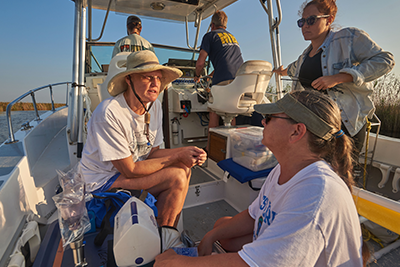
CEDB reflects a fundamental emphasis on modern biological research as applied to environmental systems and provides a vital program of research and education.

More than a Map: Geographic Information helps us answer the question "Where?" The GeoData Center is here, guiding UWF students, faculty and staff through the geo-spatial technologies changing the way we view the world.

The Institute for Analytics and Industry Advancement strives to train the next generation of industry pioneers and to develop innovative technologies through predictive analytics and modeling.

SURP Symposium
The Summer Undergraduate Research Program (SURP) allows students to fully invest in the research experience for the summer semester culminating in a presentation event on July 31.




Hal Marcus College of Science and Engineering News

UWF Launches Center for Cybersecurity and AI to Advance National and Global Impact
The University of West Florida is proud to announce the official expansion of its nationally recognized Center for Cybersecurity to the UWF Center for Cybersecurity and AI, signifying the center’s expanded mission to become a global leader in advancing secure, responsible and trustworthy digital and intelligent systems.

UWF awarded $2 million NSF grant to support STEM students
The University of West Florida has received a $2 million, six-year National Science Foundation S-STEM Track 2: Implementation grant to support academically talented, financially disadvantaged students pursuing degrees in science, technology, engineering and mathematics. The award will provide scholarships to 38 Pell-eligible STEM students while embedding expanded mental health resources within the existing STEM Living Learning Community.

UWF researchers advance AI tools for wildfire damage mapping and environmental monitoring
Researchers at the University of West Florida have introduced a new benchmark dataset and evaluation of artificial intelligence methods that could greatly improve how wildfire damage is mapped and monitored at scale. The study, led by Valeria Martin, a Ph.D. student in the intelligent systems and robotics program, introduces CalFireSeg-50, a dataset built from satellite imagery and data from 50 of California’s largest wildfires between 2019 and 2023.
Hal Marcus College of Science and Engineering
11000 University Parkway
Building 4, Room 423
Pensacola, FL 32514