


Medical Laboratory Sciences
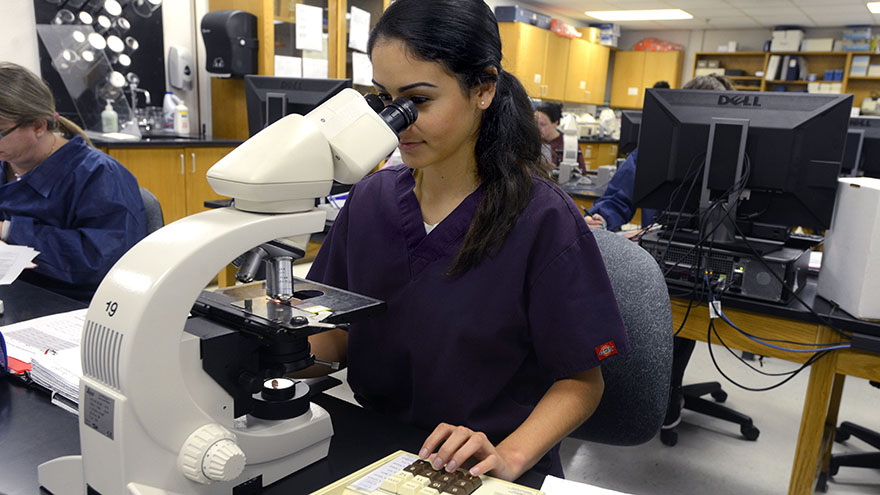
The Medical Laboratory Sciences Program is one of the primary components of the University of West Florida’s Usha Kundu, MD College of Health. The Bachelor's degree program prepares students for immediate employment in a medical laboratory as a medical laboratory scientist.
Building upon a foundation of biology and chemistry courses, the Medical Laboratory Sciences (MLS) Program prepares students to enter the MLS profession through advanced training in the medical laboratory sciences.
Graduating with a bachelor’s degree in Clinical Laboratory Sciences from the University of West Florida may not fulfill licensure requirements for every state, particularly NY and CA. Please research your potential state licensure requirements.
Upon completion of the program and the achievement of certification and license, medical laboratory scientists are employed in a variety of health-care settings as laboratory technologists, progressing to supervisory and management positions. Others work in research labs, reference labs, public-health labs, blood banks, crime labs, and physicians’ office labs. Graduates take the national board examination offered by the American Society for Clinical Pathology to be credentialed as MLS (ASCP). Alumni work in microbiology, hematology, clinical chemistry, molecular diagnostics and transfusion services. MLS graduates from UWF make significant contributions to the health and welfare of the public in Florida, Alabama and nationwide.
The UWF program is accredited by the National Accrediting Agency for Medical Laboratory Sciences. Information about NAACLS can be obtained from:
NAACLS
5600 N. River Road Suite 720
Rosemont, IL 60018-5119
773.714.8880
naacls.org
Program Outcomes
The following outcomes statistics are calculated using the formulas required by the NAACLS Annual Report.
| Program Rates | 2023 | 2024 | 2025 | 3-Year Average |
|---|---|---|---|---|
| Certification Rate | 88% | 87% | 86% | 87% |
| Graduation Rate | 97% | 96% | 98% | 99% |
| Placement Rate | 96% | 95% | 98% | 97% |
| Program Rates | 2023 | 2024 | 2025 | 3-Year Average |
|---|---|---|---|---|
| Certification Rate | 89% | 78% | 94% | 87% |
| Graduation Rate | 100% | 100% | 100% | 100% |
| Placement Rate | 96% | 94% | 93% | 95% |
| Program Rates | 2023 | 2024 | 2025 | 3-Year Average |
|---|---|---|---|---|
| Certification Rate | 80% | 88% | 70% | 82% |
| Graduation Rate | 100% | 100% | 97% | 99% |
| Placement Rate | 100% | 100% | 100% | 100% |
| Program Rates | 2023 | 2024 | 2025 | 3-Year Average |
|---|---|---|---|---|
| Chemistry Certification Rate | 90% | 100% | 100% | 94% |
| Hematology Certification Rate | 89% | 88% | 100% | 89% |
| Microbiology Certification Rate | 100% | 100% | 100% | 100% |
| Graduation Rate | 97% | 84% | 100% | 88% |
| Placement Rate | 88% | 89% | 100% | 89% |

